The excitement of a new home in Florida can quickly be overshadowed by the stress of the move itself. You’re juggling checklists and packing boxes, all while trying to navigate the process of hiring professional movers in Florida. The fear of surprise fees, damaged heirlooms, and unreliable crews is a common concern—turning what should be a positive experience into a source of anxiety.
These services fall under the broad category of residential moving, which is the most common type of relocation. Many companies also offer commercial and specialized solutions, depending on your needs.
That’s why we created this complete guide to a stress-free relocation. We believe you deserve confidence and peace of mind on moving day. Inside, you’ll learn exactly how to identify a reputable, skilled moving company, understand pricing structures to avoid hidden costs, and protect your belongings from start to finish. This expert, step-by-step plan will empower you to make an informed decision—ensuring your possessions are handled with care and your move is as smooth and efficient as possible.
Key Takeaways
- Start by defining whether your move is local or intrastate (within Florida), because pricing and planning can differ based on distance and logistics.
- Follow a proven vetting process to properly compare licensed and insured movers in Florida and avoid unreliable companies.
- Learn to decode your moving quote so you understand exactly what you’re paying for and prevent unexpected costs on moving day.
- Plan ahead for Florida’s unique logistical challenges, from navigating summer heat to preparing for potential storms and HOA/condo rules.
Table of Contents
- First Steps: Understanding the Types of Movers in Florida
- How to Choose the Best Movers in Florida: A 5-Step Vetting Process
- Decoding Your Florida Moving Quote: What Are You Paying For?
- Florida-Specific Moving Tips for a Smooth Relocation
- Why Choose All American for Your South Florida Move
First Steps: Understanding the Types of Movers in Florida
Planning a move in the Sunshine State begins with one crucial step: defining the scope of your relocation. Florida is a large state, and moving from one city to another can involve different planning needs than a neighborhood move—even when you never leave Florida. Understanding the difference between a local move and a longer intrastate move (within Florida) is essential for finding the right service and receiving an accurate, transparent quote from professional movers in Florida.
Before you start comparing companies, it helps to understand what a moving company does and how services are structured to meet specific needs. Most reputable movers can handle a wide range of residential relocations, but the best ones will clearly explain how pricing works and what’s included.
Local Movers: Your Neighborhood Relocation Experts
Local movers specialize in short-distance relocations and typically focus on speed, efficiency, and careful handling—especially in busy metro areas.
- Definition: Commonly defined as moves within a 50-mile radius (this can vary by company).
- Pricing: Often billed at an hourly rate, based on the number of movers and the truck size required.
- Best For: Moving within the same city (Fort Lauderdale to Fort Lauderdale) or nearby cities (Weston, Davie, Plantation, Hollywood, etc.).
- Focus: Fast, organized execution with minimal downtime so you can settle in quickly.
Intrastate Movers: Moving Across Florida (Still In-State)
If your relocation spans a larger portion of Florida (even though it’s still within state lines), it may require more detailed scheduling and a different pricing approach.
- Definition: A move that remains within Florida but goes beyond a typical local radius (often 50–100+ miles, depending on the mover).
- Pricing: Commonly quoted as a flat fee based on overall scope, time, distance, and logistics (instead of pure hourly billing).
- Best For: Relocations between distant Florida cities (for example, South Florida to Central Florida).
- Requirements: Movers must be properly registered and licensed for intrastate household goods transport in Florida.
How to Choose the Best Movers in Florida: A 5-Step Vetting Process
A quick online search will give you dozens of options, but choosing the first company you see is a recipe for disaster. Investing a small amount of time upfront to properly vet potential movers can save you from major headaches, hidden fees, and damaged belongings. This simple process helps you focus on legitimacy and reputation so you can sidestep unreliable operators and find trustworthy movers in Florida. Your goal is to create a shortlist of 3–4 professional companies to request detailed quotes from.
Step 1: Verify Licensing and Insurance
This is the most critical step to avoid fraudulent movers. Every legitimate moving company operating within Florida must be registered with the Florida Department of Agriculture and Consumer Services and have an active license number (commonly shown as an FL IM #).
Also ask for proof of coverage that protects you and your property:
- Liability/valuation options (what protection is included vs optional upgrades)
- Proof they can provide a Certificate of Insurance (COI) if your building requires it
- Workers’ compensation (important protection if someone is injured on your property)
Never hire a mover who cannot provide these credentials.
Step 2: Check Reviews and Ask for Referrals
Look beyond curated testimonials on a company website. Check independent review platforms like Google, Yelp, and BBB for unbiased feedback. Don’t just count stars—look for patterns:
- Do customers mention punctuality, communication, and careful handling?
- Are there repeated complaints about surprise fees or damaged items?
- Does the company respond professionally to negative reviews?
Also ask friends, family, and community groups for personal recommendations.
Step 3: Get Multiple In-Home or Video Estimates
Never accept a quote over the phone without a visual survey. A professional estimator needs to see your inventory to provide an accurate written estimate. Schedule at least three in-home or video consultations so you can compare pricing and professionalism fairly.
During the walkthrough, show everything—including closets, garages, storage rooms, patio items, and any specialty pieces.
Step 4: Watch for Red Flags and Common Scams
Be cautious if you encounter any of the following:
- An unusually low quote that feels too good to be true (often a bait-and-switch)
- A demand for a large cash deposit upfront
- Vague communication or no physical business presence
- Movers showing up in unmarked rental trucks
- Refusal to provide a detailed, written estimate that lists services and charges
Step 5: Compare Quotes and Make Your Decision
Once you have written estimates, compare them line-by-line—not just the final price. Review:
- What services are included (packing, materials, disassembly/reassembly)
- Valuation coverage options
- Potential extra charges (stairs, elevators, long carry, tight access)
- Professionalism and responsiveness during the quoting process
Choose the mover with the best combination of transparency, experience, and reliability—not just the cheapest number.
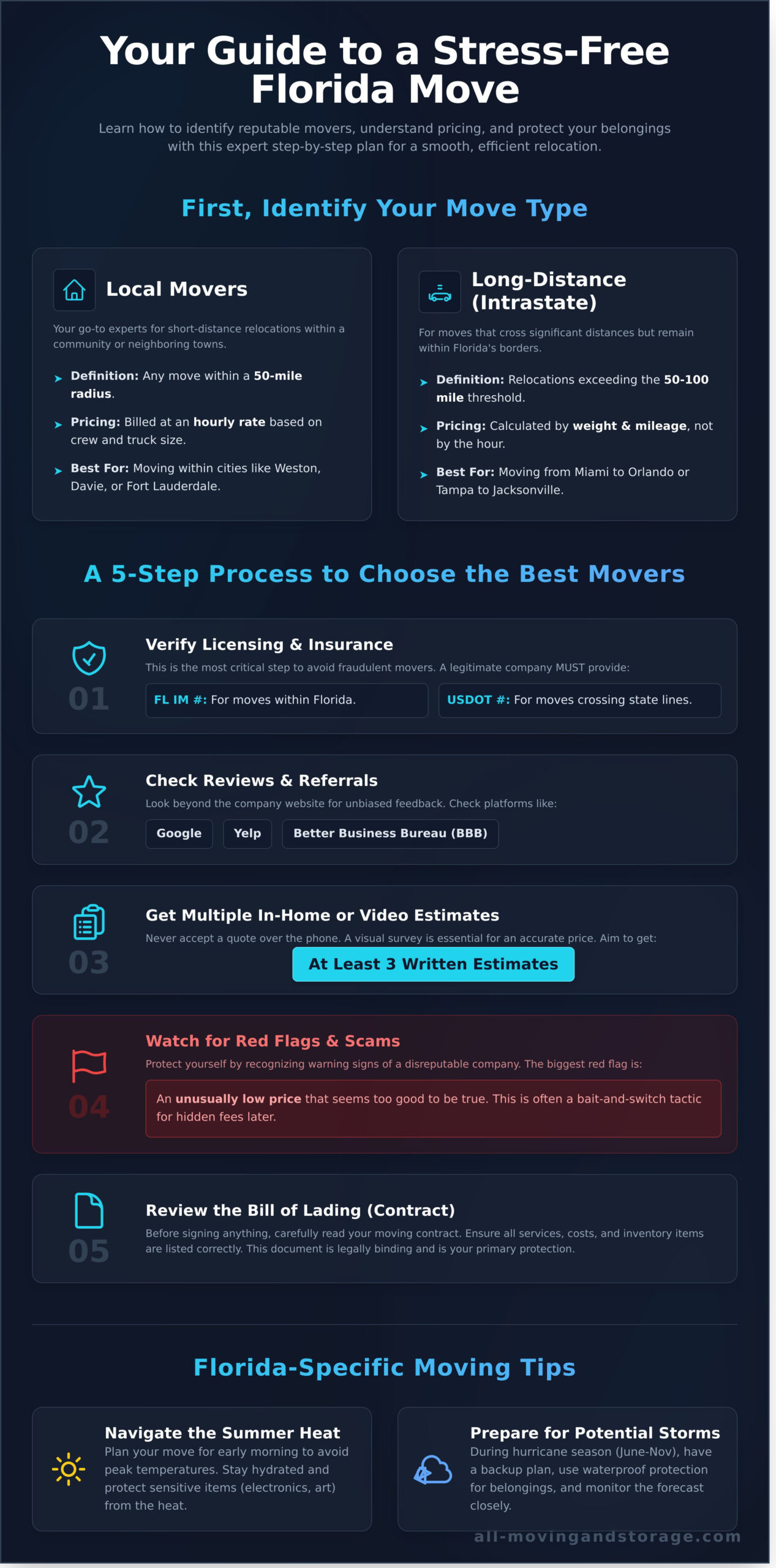
Hiring Movers in Florida: The Complete Guide to a Stress-Free Relocation – Infographic
Decoding Your Florida Moving Quote: What Are You Paying For?
A moving quote can seem complicated, but understanding its components is the key to a stress-free budget. A professional estimate provides a clear breakdown of all costs, helping you avoid surprises. Always insist on a written quote so you can compare services between different movers in Florida.
Hourly Rates vs. Flat-Fee Pricing
For many Florida moves, companies charge an hourly rate that covers the truck and crew. Always confirm:
- When the clock starts/stops (travel time policies vary)
- Minimum hours required
- Whether supplies or equipment are included
For larger in-state moves, some companies provide a flat fee. For maximum peace of mind, ask about a binding or not-to-exceed estimate—so your final bill won’t exceed the agreed amount unless you add items or services.
Standard Inclusions vs. Potential Extra Charges
Most quotes cover the basics: labor, truck, and transport. Additional charges may include:
- Packing Materials: boxes, tape, paper, bubble wrap
- Accessorial Fees: stairs, elevator delays, long carries
- Specialty Items: pianos, safes, oversized antiques, fragile art
- Packing/Unpacking Services: full or partial packing assistance
- Furniture Disassembly/Reassembly: beds, large tables, sectionals, etc.
A reputable mover will explain these clearly before you sign.
Understanding Valuation Coverage (Moving Protection)
By law, movers typically offer a basic level of valuation coverage, but it can be minimal. Ask your mover to explain:
- What basic coverage includes
- Optional full value protection
- Whether third-party insurance is available or recommended for high-value items
The key is to understand your protection before moving day.
Florida-Specific Moving Tips for a Smooth Relocation
Moving to or within Florida comes with unique challenges—heat, humidity, storms, and strict building rules in many communities. Planning ahead and communicating clearly with your movers in Florida makes all the difference.
Navigating Weather: Heat, Humidity, and Hurricane Season
Florida’s climate impacts timing and safety. Hurricane season runs June through November, and summer heat can be intense.
- Schedule early: Morning moves are usually cooler and safer
- Protect sensitive items: electronics, candles, artwork, and vinyl should not sit in heat too long
- Plan for flexibility: storms can cause delays—ask about rescheduling policies
- Stay hydrated: have water available and keep pathways clear to help your crew work safely
Dealing with HOAs and Condo Associations
Many Florida communities have strict moving rules. Confirm in advance:
- Approved moving hours
- Service elevator reservations
- COI requirements
- Where the truck can park / loading dock access
- Protection requirements for common areas
Share these details with your mover early to avoid delays and fines.
Planning Around Peak Moving Season
Florida’s peak season often runs through warmer months and end-of-month dates. To secure your ideal date:
- Book 4–6 weeks in advance whenever possible
- Consider mid-week or mid-month for better availability
- Avoid last-minute bookings during peak times if you want top crews and pricing
Ready to plan your move with a team that understands Florida’s unique demands? Get a free, professional estimate today!
Why Choose All American for Your South Florida Move
After researching your options and understanding what to look for in a moving company, it’s time to see how a trusted local partner measures up. As a family-owned business, we aren’t just another listing of movers in Florida—we’re your neighbors, serving South Florida with professionalism and care.
Our Commitment to Transparent Pricing
We provide detailed written estimates with no hidden fees. Our consultants walk you through every line item so you understand exactly what you’re paying for—before moving day.
Fully Licensed, Insured, and Professional
Your peace of mind is our priority. When you work with us:
- We are fully licensed by the state of Florida (FL IM #2933)
- We are comprehensively insured
- Our team is trained, uniformed, and committed to excellent customer care
A Full Suite of Services
We are your complete relocation partner, offering professional packing, secure storage solutions, and careful handling for residential moves throughout South Florida. When you want professional movers in Florida who put your needs first, we’re here to help.
Experience a stress-free move. Get your free quote now!
Your Stress-Free Florida Move Starts Here
Relocating in Florida is an exciting chapter, and it doesn’t have to be overwhelming. With the right preparation—vetting your mover carefully, understanding your quote, and planning for Florida’s unique conditions—you can ensure a smooth transition. The key is choosing a partner you can trust.
When you’re ready to hire professional and reliable movers in Florida, look no further than All American Moving and Storage. As a family-owned and operated business, we are committed to dependable, high-quality service. We’re fully licensed and insured (FL IM #2933) for your peace of mind, and we offer packing and storage solutions to handle all your needs.
Ready to get started? Get Your Free, No-Obligation Moving Quote today and experience a truly stress-free relocation.
Frequently Asked Questions
How much do movers typically cost in Florida?
Local moves are commonly priced by the hour and vary based on home size, access, and how many movers are needed. The most accurate way to budget is to request a detailed written estimate after an in-home or virtual survey so you understand the full scope of pricing upfront.
How far in advance should I book a moving company in Florida?
We recommend booking at least 4–6 weeks in advance, especially during peak months, weekends, and end-of-month dates. Booking early helps you secure your preferred move date and ensures better availability with top crews.
What is the difference between a moving broker and a moving company?
A moving company provides the actual service with its own trucks and crew. A broker arranges the move and may assign it to another company. Working directly with a licensed moving company typically offers clearer communication and more direct accountability.
Are my belongings automatically insured when I hire movers?
Movers usually provide a basic level of valuation coverage, but it may not reflect full replacement value. Ask your mover to explain what protection is included and what options are available for more comprehensive coverage—especially for high-value items.
Do I need to empty drawers before the movers arrive?
Yes, it’s best to empty drawers. It reduces weight, prevents shifting contents, and lowers the risk of damage to furniture and floors. Light clothing may be okay in some cases, but removing everything is the safest approach.
Is it customary to tip movers in Florida, and if so, how much?
Tipping is not required, but it’s appreciated for excellent service. Many customers tip a flat amount per mover based on the time and difficulty of the job, or leave a tip that reflects overall satisfaction. A positive review is also a helpful way to support a great crew.