
Would you trust a million dollar oil painting to a contract that values it at just 60 cents per pound? With the global fine art logistics market projected to reach $3.35 billion in 2026, collectors are realizing that high value assets require more than just a standard truck. You likely feel the weight of responsibility when moving your collection, especially with the fear of irreparable damage or the complexity of coordinating specialized packing during a general home move. It’s a stressful process that demands absolute precision and a partner who understands the stakes.
You can find a fine art moving company you trust by looking for specific, modern standards that go beyond basic transport. This guide provides the essential framework for hiring experts who offer museum quality packing and climate controlled solutions. We’ll show you how to verify credentials under the new USDOT only identifier system that replaced legacy MC numbers in late 2025. You will also learn why maintaining a strict environment of 65 to 75 degrees Fahrenheit is non negotiable for protecting your investments during a 2026 relocation. We are here to help you secure total peace of mind so you can focus on your new home while your collection remains in safe, professional hands.
Key Takeaways
- Learn how to distinguish “white glove” services from standard movers by auditing specialized transit insurance and museum-grade packing materials.
- Discover the 4-layer protection system designed to safeguard high-value items against surface damage, moisture, and mechanical shock.
- Understand the specific risks of South Florida’s humidity and how a professional fine art moving company prevents canvas warping and adhesive failure.
- Identify when your collection requires soft-packing versus custom-engineered wooden crates for maximum security during long-distance transport.
- Streamline your relocation by integrating your household move with specialized art transport to ensure a single, accountable team handles your entire estate.
What Defines a Professional Fine Art Moving Company?
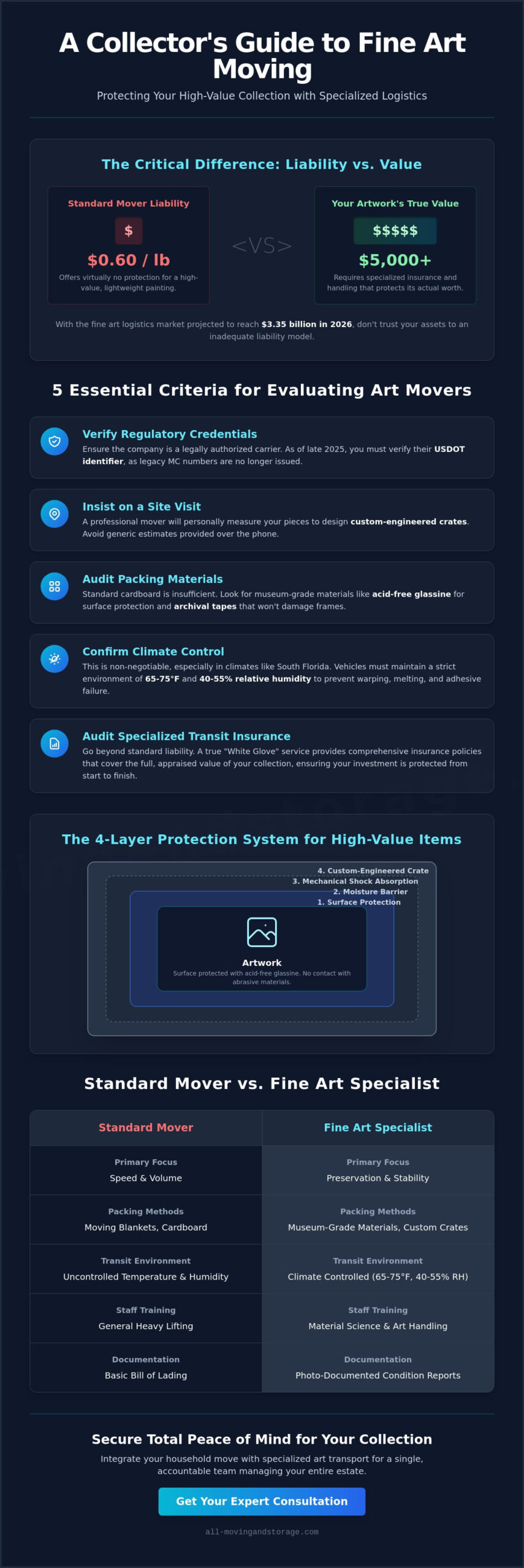
A professional fine art moving company operates as a specialized engineering firm rather than a traditional freight carrier. While standard residential services focus on the efficient transport of household goods, fine art logistics prioritize the preservation of material integrity through custom engineered packing. This distinction becomes critical for any collection where individual pieces are valued over $5,000. At this price point, the standard moving industry liability of 60 cents per pound offers virtually no protection for your assets. Specialized movers provide a true “White Glove” service, which means every touchpoint is planned by a dedicated Move Coordinator. This expert acts as your single point of contact, managing everything from climate requirements to the scheduling of specialized equipment.
Choosing a fine art moving company ensures that your collection is treated as a priority rather than just another crate on a truck. Standard movers often prioritize speed and volume. In contrast, art movers prioritize stability and environmental control. This specialized approach is necessary because high value items require specific packing protocols that standard moving blankets cannot provide. We focus on creating a secure environment that mitigates the risks of vibration, pressure, and temperature shifts during transit.
The Anatomy of an Art Handler’s Expertise
The foundation of a reliable service lies in the skill of professional art handlers. These experts undergo rigorous training that extends far beyond heavy lifting. They must understand material science, such as how 80% humidity in South Florida can cause canvas tension to shift or how specific adhesives in mixed media pieces react to heat. Whether they are securing a 200 pound marble bust or a delicate 19th century oil painting, their goal remains the same. Museum quality handling is a standard of zero contact surface protection where the artwork is never touched by bare skin or abrasive materials.
Inventory Management and Condition Reporting
Trust is built through transparency and meticulous documentation. A professional move begins with a comprehensive digital inventory. Our team uses high resolution photo documentation to record the state of every piece before it ever leaves your wall. These condition reports are essential because they establish a baseline for insurance purposes and protect your investment throughout the relocation. By standardizing the “Chain of Custody,” we ensure that every person who handles your collection is logged and accountable. This structured approach transforms a high stress event into a predictable, secure process for every collector.
5 Essential Criteria for Evaluating Art Movers
Evaluating a fine art moving company requires a shift in perspective from cost to risk management. You aren’t just buying a truck and labor; you’re investing in a specialized protection system. The first step is verifying their regulatory credentials. As of October 1, 2025, the FMCSA no longer issues MC numbers, so you must verify your mover using their USDOT identifier. This ensures they’re a legally authorized carrier under the latest federal standards. Beyond registration, a site visit is non negotiable. A professional mover should personally measure your pieces to design custom crates, rather than providing a generic estimate over the phone.
Packing materials are the next critical audit point. Standard cardboard and plastic wrap are insufficient for high value assets. Professional handlers use acid-free glassine to protect the surface of oil paintings and archival tapes that won’t damage delicate frames. For a deep dive into these technical requirements, the Smithsonian Institution provides a definitive guide on packing and transporting paintings. If your mover’s inventory doesn’t include these museum grade materials, your collection is at risk.
Climate control is your primary defense against the South Florida environment. In regions like Weston and Davie, uncooled trucks can reach internal temperatures that cause varnishes to melt or canvas tension to snap. Ensure your mover uses vehicles that maintain a consistent 65 to 75 degree environment with 40% to 55% relative humidity. This stability is essential for preserving the chemical integrity of your art during transit.
Insurance and Liability: Protecting Your Investment
Standard “Released Value Protection” only pays 60 cents per pound, which is useless for a $10,000 sculpture. You need “Full Value Protection” or a third party transit policy. Always check for exclusions regarding antique furniture or items with “inherent vice.” If you’re coordinating a larger household move, it’s helpful to review Your Guide to Choosing the Best Fort Lauderdale Moving Company to see how specialized art coverage integrates with your total relocation package.
Technology in Art Logistics
Modern art transport relies on data. Look for movers who offer real time GPS tracking and impact sensors that monitor G-force and tilt throughout the journey. This technology provides an objective record of handling and offers peace of mind while your assets are on the road. For collections in transition, ask about digital vaulting and secure storage solutions. These systems keep your inventory organized and protected in a climate controlled facility until your new space is ready. If you’re planning a relocation, you can request a specialized quote to see how these technologies protect your collection.
Specialized Packing and Crating Protocols for High-Value Items
When you hire a professional fine art moving company, you are paying for an engineered defense system designed to counteract the physical stresses of transit. This system relies on a 4-layer protection protocol. The first layer addresses surface protection, followed by shock absorption, moisture barriers, and finally, a rigid exterior shell. Acid-free glassine is the industry standard for oil painting surfaces because its pH-neutral and non-static properties prevent the material from sticking to or chemically reacting with the delicate varnish. Without these specific layers, even a short trip across town can result in micro-abrasions or structural cracks that diminish a piece’s value.
The choice between soft-packing and custom wooden crating depends on the fragility, value, and travel distance of the item. Soft-packing uses high-density foam and double-walled cardboard for items with lower risk profiles. However, for high-value assets or 3D sculptures, “Shadow Boxing” is the preferred method. This technique involves building an internal framework within a crate to suspend the item. This ensures the artwork never touches the crate walls, allowing the crate to absorb external impacts while the art remains stationary in its protected “shadow.”
Custom Crating: Engineering for the Journey
Reliable art movers use ISPM-15 certified wood for all custom crates. This heat-treated lumber is required for international travel, but it is also a best practice for domestic moves because it’s free of pests and fungi that could contaminate your collection. Inside the crate, handlers calculate the correct foam density based on the item’s weight. Too much cushion allows for excessive movement, while too little fails to dampen vibrations. For collectors who move items between residences frequently, we design easy-open crates with reusable bolt systems rather than traditional nails, which preserves the crate’s structural integrity over time.
Handling Fragile Materials: Glass and Marble
Fragile mediums like glass and marble require specific mechanical handling rules. For framed pieces with glass, we often use specialized glass-skin or the “X” taping method to prevent shards from damaging the canvas if a break occurs. Marble presents a different challenge due to its weight and brittle nature. We always transport marble slabs or tabletops “on edge” in a vertical position. Carrying marble flat creates a high risk of snapping under its own weight during a vehicle’s bounce. To ensure your entire relocation is as organized as your art transport, refer to our Movers Fort Lauderdale FL: The Ultimate Relocation Checklist for a seamless experience.
Navigating the Challenges of Moving Art in South Florida’s Climate
South Florida’s environment is notoriously hostile toward fine art. When humidity levels spike above 80%, canvas tension fluctuates rapidly. This can lead to “craquelure” or surface cracking over time. A professional fine art moving company treats these environmental factors as primary hazards. Heat is equally dangerous. In a standard trailer, temperatures can climb high enough to soften traditional varnishes or cause adhesives in mixed-media pieces to fail. We prevent this by utilizing specialized vehicles that maintain a steady environment from door to door.
Logistics in communities like Weston and Davie add another layer of complexity. These areas often feature gate-guarded access and narrow residential streets that aren’t suitable for large freight carriers. Our team coordinates with HOAs and security personnel in advance to ensure a smooth transition. Once the art arrives, we implement a mandatory acclimatization period. You shouldn’t uncrate your items immediately. Allowing the crates to sit for 24 hours helps the materials stabilize to the new indoor environment and prevents moisture from condensing on the artwork’s surface.
Climate-Controlled Storage Solutions
There’s a significant difference between air cooled and climate controlled storage. Air cooled units only manage temperature, but true climate controlled solutions regulate both temperature and moisture. For high-value art, we maintain a strict standard of 70°F and 50% relative humidity. This balance prevents mold growth and material warping. If you need a secure space for your collection, consider our specialized Your Trusted Moving Company in Fort Lauderdale, FL for comprehensive care.
Storm Season Logistics
Florida’s storm season requires tactical planning. Afternoon thunderstorms can appear in minutes, creating a high risk of moisture exposure during loading. We use heavy-duty waterproofing protocols and sealed ramps to keep items dry. Our team also maintains emergency contingency plans for hurricane-related delays. We prioritize the safety of your collection above all else, adjusting schedules as needed to avoid hazardous conditions. Protect your collection from the elements by choosing a partner who understands the local environment. You can contact us today for a specialized quote on your climate-sensitive relocation.
Why All American Moving And Storage is Your Trusted Fine Art Partner
Relocating a high value collection shouldn’t require managing multiple vendors. Many collectors face the stress of hiring one company for their furniture and another fine art moving company for their gallery pieces. All American Moving And Storage eliminates this complexity by offering full service integration. Our team handles your entire household move while applying museum grade protocols to your most valuable assets. This all-in-one approach ensures that your collection stays under the supervision of a single, accountable team from the moment we enter your home until the final installation.
As a family owned business, we treat your collection like our own heritage. We understand that these aren’t just assets; they’re often sentimental pieces that require a personal touch. Our local expertise in Weston, Davie, and the broader South Florida region allows us to navigate the specific logistical hurdles of the area with ease. We provide transparent quoting with no hidden fees for specialized crating or handling. You’ll receive a clear, professional estimate that covers every aspect of your move, providing the reliability you expect from an industry leader.
Our White Glove Commitment
Every high value relocation team we deploy includes certified art handlers who specialize in delicate material science. We use state of the art equipment, including air ride suspension vehicles and specialized hydraulic lifts, to ensure a smooth journey. Our commitment is to provide a stress free experience. We manage the heavy lifting and the technical engineering so you can focus on your transition. Whether you’re moving a single sculpture or an entire private gallery, our professional care remains consistent and dependable.
Get Your Custom Fine Art Moving Quote Today
Preparing for an art move requires careful planning and clear communication. To help us provide the most accurate assessment during your consultation, please have the following information ready:
- High resolution photos of each piece, including the front, back, and any existing hardware.
- Exact dimensions including the height, width, and depth of the artwork and its frame.
- Current appraisals or estimated values for insurance and Full Value Protection documentation.
- Installation requirements for the new location, such as wall types or pedestal needs.
Our goal is to provide a seamless relocation that prioritizes safety and efficiency. We’ve spent years refining our process to meet the 2026 standards of the global art market. When you’re ready to move your collection with a partner who values professional care, we’re ready to help. Request Your Free Art Moving Quote Now and let our experts secure your priceless assets for their next journey.
Protecting Your Legacy for the Next Chapter
Relocating a high value collection requires more than just transport; it is a technical commitment to preservation. You now understand that a qualified fine art moving company must provide engineered crating and strict climate controls to mitigate the risks of South Florida’s 80% humidity. By verifying credentials under the post-2025 USDOT system and ensuring the use of pH-neutral materials like acid-free glassine, you protect your assets from both physical and chemical damage during transit.
We’ve spent over 10 years serving the communities of Weston and Davie as a fully insured and licensed Florida mover. Our team combines specialized crating expertise with a dedicated white glove approach to ensure every piece arrives in its original gallery condition. We are ready to manage the complex logistics of your move while you focus on settling into your new residence. You deserve a relocation where safety and professionalism are the primary standards.
Secure Your Collection with a Free White Glove Moving Quote
Your collection represents a significant investment in culture and heritage. With the right expert partner, you can move forward with total confidence that your priceless items are in capable hands.
Frequently Asked Questions
What is the difference between a regular mover and a fine art moving company?
A fine art moving company differs from a standard mover by employing museum trained handlers who prioritize material science over speed. Standard movers often use generic blankets and plastic wrap that don’t protect against chemical reactions or micro-vibrations. Our specialized teams use acid-free glassine and custom engineered crates to ensure zero contact surface protection. This specialized approach is necessary to maintain the provenance and market value of high value assets.
How much does it cost to move a fine art collection?
Move costs depend on the number of custom crates required and the total valuation of your collection. Industry data from 2026 shows that fine art insurance typically costs between 1% and 2% of the artwork’s value annually. We provide a transparent quoting process that includes all specialized packing materials and labor up front. This avoids the hidden fees often found in standard estimates that don’t account for the technical complexity of art logistics.
Do you provide climate-controlled storage for art in South Florida?
We provide dedicated climate-controlled storage that maintains a strict environment of 70 degrees Fahrenheit and 50% relative humidity. This is a higher standard than “air-cooled” storage, which only regulates temperature without managing moisture levels. In South Florida’s volatile climate, controlling humidity is the only way to prevent mold growth and canvas warping. Our facility is designed to protect your collection from outdoor humidity levels that frequently exceed 80%.
Can you handle the installation of large or heavy sculptures?
Our team manages the rigging and installation of large or heavy sculptures using specialized equipment like hydraulic lifts and floor protection runners. We assess the floor load capacity of your residence to ensure a safe placement for every piece. Whether it’s a 200 pound marble bust or a large mixed media installation, we ensure the piece is balanced and secured. This technical expertise prevents the structural stress that occurs during amateur handling.
What kind of insurance do I need for a high-value art move?
You should secure “Full Value Protection” or specialized “All-risk” transit insurance for any high value relocation. Standard carrier liability is limited to 60 cents per pound, which is inadequate for priceless assets. All-risk policies cover damage, loss, and theft during every phase of the move. Most insurers will require a current appraisal for items valued over a specific threshold before they issue a policy for the 2026 season.
How do you protect oil paintings from the Florida humidity during a move?
We use acid-free glassine as a primary moisture barrier and transport items in climate-controlled vehicles. This prevents the “melting” of varnishes and the expansion of wood frames caused by South Florida’s extreme heat. Our handlers also observe a 24-hour acclimatization period after delivery. This allows the materials to stabilize to your home’s internal environment before we uncrate them, which significantly reduces the risk of surface cracking or craquelure.
Do I need to crate every piece of art for a local move in Weston?
Not every piece requires a wooden crate for a local move in Weston or Davie. We often use “soft-packing” for durable items or those with lower market values, utilizing multiple layers of archival wrap and double-walled cardboard. However, we always recommend custom crating for 3D sculptures and paintings with fragile frames. A site visit allows our coordinators to determine the safest and most efficient packing method for each individual piece.
How far in advance should I book a fine art moving service?
You should book your fine art moving service at least 4 to 6 weeks in advance of your relocation date. This timeframe allows our coordinators to conduct a site visit, take precise measurements, and build your custom crates. It also ensures that we can secure a climate-controlled vehicle and a certified handling team for your specific dates. Early booking is especially important during the busy Florida moving season to ensure your collection receives dedicated attention.