
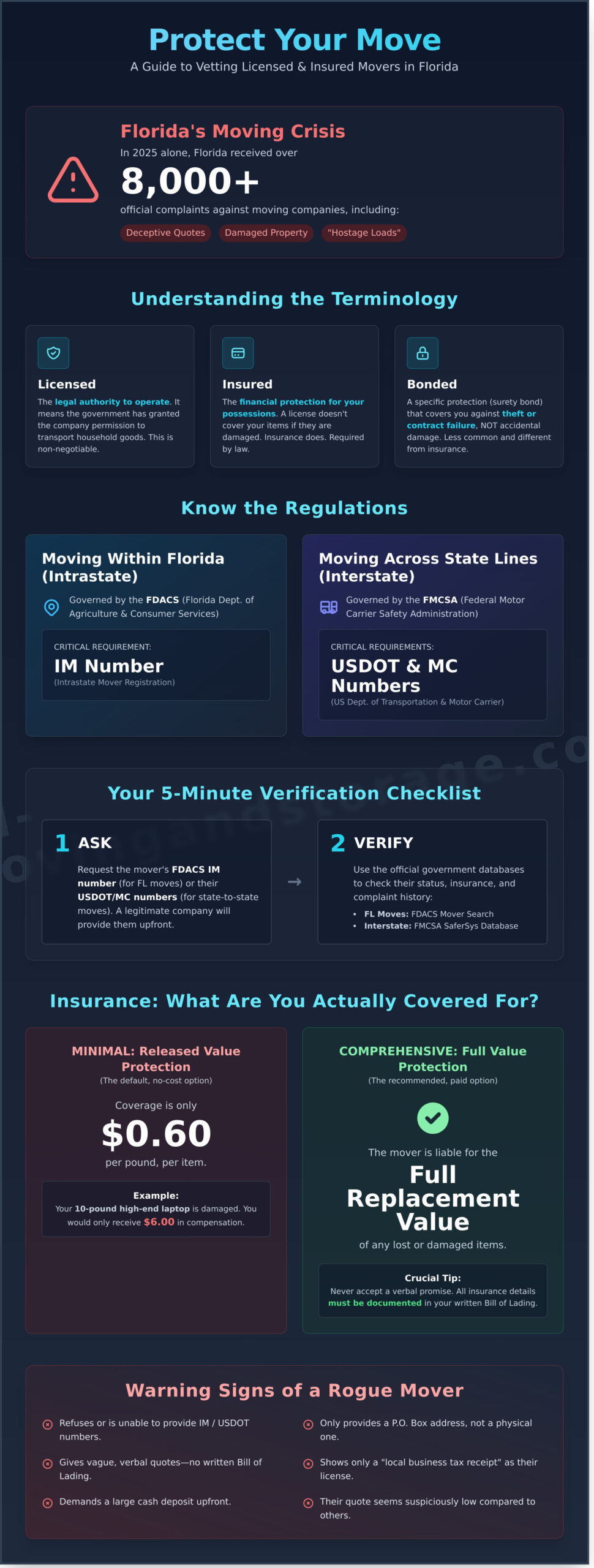
In 2025 alone, the Florida Department of Agriculture and Consumer Services received over 8,000 official complaints against moving companies, many involving deceptive quotes and damaged property. It’s a startling number that confirms a deep-seated fear for anyone planning a move: that your life’s possessions could end up in the wrong hands, or worse, held hostage for a higher fee.
You shouldn’t have to feel anxious during what should be an exciting transition. The key to a secure and stress-free move isn’t just finding a company with a good price; it’s about verifying they are professional, accountable, and legitimate. That’s why your top priority must be to hire properly licensed and insured movers. This guide will provide the clarity and confidence you need to protect your belongings. We’ll give you a simple checklist to verify any mover’s credentials, break down the real difference between insurance and basic valuation, and arm you with the knowledge to identify and avoid South Florida’s most common moving scams.
Key Takeaways
- Avoid costly moving scams like the “hostage load” by learning how to spot the red flags of an unlicensed operator before you hire them.
- Learn a simple, two-step process to verify a moving company’s credentials in under five minutes using official government websites.
- Understand the specific Florida state requirements, including the crucial ‘IM’ registration number, that all legitimate licensed and insured movers must provide.
- Discover the critical difference between a mover’s license and their insurance to ensure your belongings are actually protected from loss or damage.
What Does ‘Licensed and Insured’ Really Mean for Your Move?
When you’re searching for a moving company, the phrase “licensed and insured” appears everywhere. But it’s more than just a marketing slogan; it’s a fundamental standard of professionalism and accountability. Understanding what ‘licensed and insured’ means is the first step toward a secure, stress-free relocation. These credentials prove a mover has met strict legal and financial requirements set by government agencies, offering you a powerful layer of protection that unregulated operators simply can’t provide.
This peace of mind is invaluable. A 2021 Zillow survey identified moving as more stressful than divorce or starting a new job for many Americans. Choosing professional, credentialed movers directly reduces that anxiety by confirming your belongings are handled by a legitimate business held to high standards. For any move crossing state lines, the company must be registered with the U.S. Department of Transportation (USDOT) and the Federal Motor Carrier Safety Administration (FMCSA). For moves within Florida, they must be registered with the Florida Department of Agriculture and Consumer Services (FDACS) and hold a specific IM (Intrastate Mover) number. These aren’t just letters and numbers; they are your assurance of a mover’s legitimacy.
The Difference Between Licensing and Insurance
It’s a common mistake to think these two terms are interchangeable. Licensing is simply the legal authority to operate. It means the government has granted the company permission to transport household goods. Insurance, on the other hand, is the financial protection for your possessions. A license doesn’t automatically cover your items if they are damaged. Federal law requires interstate movers to offer two basic liability options: Released Value Protection, which provides minimal coverage at $0.60 per pound per item, and Full Value Protection, which is more comprehensive. Never accept a verbal promise of coverage; all insurance details must be clearly documented in your written Bill of Lading.
Why ‘Bonded’ is Often Misunderstood
You might also see the term “bonded,” but its meaning is very specific. A surety bond is not the same as cargo insurance. A bond protects you if the company fails to fulfill its contractual obligations, most often in cases of employee theft or if the company doesn’t pay for damages it’s legally liable for. It does not cover accidental damage to your furniture during transit; that is the role of insurance. When vetting licensed and insured movers, check their website for their USDOT and FDACS IM numbers. Reputable companies display these credentials proudly. If they are hidden or missing, consider it a significant warning sign.
Florida-Specific Moving Regulations You Must Know
Moving within Florida isn’t a free-for-all. The state has established a clear set of rules designed to protect you from rogue operators and ensure a baseline of professionalism. Understanding these regulations is the first step in hiring a trustworthy moving company. The primary governing body for moves that start and end within the state is the Florida Department of Agriculture and Consumer Services (FDACS). Their oversight ensures that movers meet specific insurance, safety, and operational standards before they can legally transport your belongings.
These state-level rules provide a critical safety net. They separate legitimate businesses from individuals with a truck who operate without accountability. Before you even ask for a quote, you should know the legal framework that protects your move.
FDACS Registration: The Florida Requirement
For any move within Florida, a moving company must be registered with FDACS and have an active Intrastate Mover (IM) number. This isn’t optional. You can verify a company’s status in less than 60 seconds by searching the FDACS Mover Registration database. Be wary of movers who only show a local business tax receipt; this is simply a permit to operate a business in a city and offers zero proof of the required insurance or consumer protection compliance. A legitimate mover will also have a physical office address, not just a P.O. Box, which gives you a point of contact if an issue arises.
USDOT and MC Numbers for Long-Distance Moves
When your move crosses state lines, federal law takes precedence. The Federal Motor Carrier Safety Administration (FMCSA) requires all interstate movers to have a U.S. Department of Transportation (USDOT) number and a Motor Carrier (MC) number. The USDOT number tracks safety records, while the MC number grants the legal authority to transport household goods between states. You can check any mover’s federal credentials, insurance status, and complaint history using the FMCSA’s online SaferSys database. This transparency is why All American Moving and Storage proudly maintains both our Florida IM registration and our federal USDOT and MC numbers, ensuring full compliance for any move, near or far.
Your consumer rights are further protected by state law. Florida Statute Chapter 507 outlines the legal responsibilities of household movers, including the requirement to provide written estimates and detailed contracts. Hiring licensed and insured movers who adhere to this statute is your primary defense against unexpected charges and disputes. Beyond state law, companies operating in specific municipalities like Weston or Davie must also comply with local ordinances regarding commercial vehicle operation and business permits. This layered compliance is a hallmark of a professional moving service.
The FMCSA provides extensive resources, including a complete guide to Federal moving regulations, to help you make an informed decision. Verifying these credentials is the best way to ensure you’re working with true professionals. If you have questions about a specific move, our team can walk you through the documentation and insurance we provide for every single job. Choosing properly licensed and insured movers isn’t just about following rules; it’s about securing peace of mind.
The Risks of Hiring Unlicensed ‘Cowboy’ Movers
That incredibly low quote you found on a classifieds site can seem tempting. Why pay more? The answer is simple: that low price is often bait. Hiring an unvetted, unlicensed operator exposes you to significant financial, legal, and personal risks that can turn your move into a nightmare. The Federal Motor Carrier Safety Administration receives over 5,000 complaints about movers each year, many involving these exact ‘cowboy’ operations. The peace of mind that comes with hiring licensed and insured movers is a direct shield against these predatory tactics.
A common and devastating scam is the ‘hostage load.’ It starts with a low, verbal quote. Once your life’s possessions are loaded onto their truck, the price suddenly skyrockets. They present you with a new bill, often thousands of dollars higher, citing vague fees for “stair carries” or “long-haul surcharges.” They refuse to unload your furniture until you pay their exorbitant demand in cash. With no license to lose or reputation to protect, you have little recourse. That ‘too good to be true’ quote becomes the most expensive move of your life.
Beyond financial scams, the rise of the ‘gig economy’ moving sector introduces personal safety risks. Reputable moving companies conduct mandatory background checks and drug screenings on all employees. An unvetted crew hired through an app or online marketplace has no such oversight. You are inviting complete strangers into your home, around your family, with no verification of their history or reliability.
Financial Liability for Damage and Injuries
What happens if an uninsured mover slips and breaks their leg on your property? You could be held liable. Professional movers carry workers’ compensation insurance to cover their employees, protecting you completely. An unlicensed operator or ‘day laborer’ has no such coverage. This leaves you legally vulnerable, and your homeowner’s policy will likely deny a claim for a worker you hired ‘under the table,’ potentially leading to a personal lawsuit against you for their medical bills.
The ‘Rogue Mover’ Red Flags
Protect yourself by learning to spot the warning signs of an illegitimate operation. These movers count on you not knowing what to look for. Be vigilant and watch for these red flags:
- Vague or Verbal Quotes: A professional company provides a detailed, written estimate. A rogue mover avoids putting anything in writing. They may refuse to provide a binding quote, which locks in the price.
- Unprofessional Equipment: They show up in a rented U-Haul or an unmarked van instead of a clearly branded company truck. Legitimate companies invest in their fleet and proudly display their name and U.S. DOT number.
- No Verifiable Credentials: They are evasive when you ask for their license or insurance information. You should always check a company’s operating authority and insurance status using the federal government’s FMCSA’s SAFER system before you hire them.
- Large Cash Demands Upfront: A massive cash deposit before any work begins is a classic sign of a scam. Reputable movers have established billing practices that don’t rely on large, untraceable cash payments.
Ultimately, the risks of hiring an unlicensed mover far outweigh the perceived savings. The potential for scams, property damage, and legal liability makes choosing professional, licensed and insured movers the only secure and responsible decision for your relocation.
How to Verify a Moving Company’s Credentials in 5 Minutes
Hiring a mover feels like a leap of faith, but it doesn’t have to be. A few minutes of simple verification can protect your belongings and your wallet from rogue operators. Professional, licensed and insured movers expect you to perform your due diligence. In fact, they welcome it. Follow these five steps to confidently confirm you’re working with a legitimate and reliable company.
Step 1: Ask for Their Registration Numbers
Before you even discuss a quote, ask for two key numbers: their U.S. Department of Transportation (USDOT) number for interstate moves and their Florida Mover Registration Number (IM#) for moves within the state. A reputable company will have these readily available on their website, trucks, and paperwork.
Step 2: Verify the Numbers Online
Don’t just take their word for it. Use official government resources to check their status.
- For the USDOT number: Visit the Federal Motor Carrier Safety Administration (FMCSA) SAFER System website. A quick search confirms their operating status is “Authorized for HHG” (Household Goods) and shows their safety record.
- For the Florida IM number: Check the Florida Department of Agriculture and Consumer Services (FDACS) online portal. This confirms they are registered and legally permitted to perform moves within Florida.
Step 3: Request a Certificate of Insurance (COI)
This is non-negotiable. Ask the mover to provide a COI with your name and address listed as the “certificate holder.” This document is direct proof that their General Liability and Cargo insurance policies are active for the date of your move. It’s your best protection against accidental damage to your property or belongings.
Step 4: Confirm a Physical Address
Look for a verifiable, physical office and warehouse in your area, such as in Weston or Davie. Many fraudulent movers are just brokers operating from a call center with no actual trucks or staff. A local presence means real assets, real employees, and real accountability. You can even use Google Street View to see if the address is a legitimate commercial building or just a mailbox.
Step 5: Read the Bill of Lading Carefully
On moving day, you’ll be presented with a Bill of Lading. This is the legal contract between you and the moving company. Before you sign it and before they load a single box, read it. Ensure the inventory list, rates, and valuation coverage match exactly what was stated in your original estimate.
Understanding Valuation vs. Full Value Protection
It’s crucial to understand how your items are protected. Valuation is a level of liability assumed by the mover, not a third-party insurance policy. By law, movers must offer two options:
- Released Value Protection: This is the default, no-cost option. It provides minimal coverage at just 60 cents per pound per article. A 50-pound, $1,500 television would only be covered for $30.00 if damaged.
- Full Value Protection: This is the superior option. The mover is liable for the replacement value of any lost or damaged item. They can choose to repair the item, replace it with a similar one, or make a cash settlement for the cost of repair or current market value.
What to Look for in a Moving Quote
A quote from a professional mover is more than just a price; it’s a detailed plan. A key sign of a trustworthy company is their quoting process. They will insist on an in-home or detailed virtual survey to provide a binding estimate, which guarantees the price won’t change unless you add items or services. Be wary of non-binding estimates, as they can increase significantly. Also, ask directly about potential extra charges like fuel surcharges, long-carry fees (for distances over 75 feet from the truck to your door), or fees for handling stairs.
A transparent quote is the foundation of a stress-free move. Get a detailed, binding estimate from our verified moving professionals today.
All American Moving and Storage: Your Fully Credentialed Florida Partner
Understanding the value of professional movers is one thing; finding a team that embodies those principles is another. At All American Moving And Storage, we aren’t just a service provider. We are your neighbors. As a family-owned company since day one, our commitment to transparency is built into everything we do. We are fully licensed by the state of Florida (FL IM #2999) and carry comprehensive insurance policies that protect your belongings from start to finish. There are no shortcuts, just professional, reliable service.
Our deep roots in South Florida give us a distinct advantage, particularly for residents in Weston and Davie. We understand the unique logistics of moving within these communities, from navigating gated neighborhoods with specific vehicle restrictions to coordinating with high-rise building management. Our fleet includes specialized equipment, such as air-ride suspension trucks that provide a smoother journey for your fragile items and compact moving vans ideal for tight access points. This local expertise ensures your move is efficient and stress-free.
Protecting your most treasured possessions is our highest priority. We specialize in handling delicate and high-value items that other companies might refuse. Our process for moving a grand piano, for example, involves custom-built dollies, protective padding, and a skilled team of at least three certified movers. For antiques, we offer custom crating solutions. More importantly, our status as licensed and insured movers means your assets are covered. Our valuation protection plans provide clear, upfront coverage, so you have complete peace of mind knowing your heirlooms are secure.
The All American Moving And Storage difference is our ability to provide a seamless, all-in-one moving experience. We eliminate the need to coordinate with multiple vendors. Our comprehensive services include:
- Professional Packing: Our teams use industry-best materials and techniques to ensure every item is packed securely for transit.
- Secure Storage: We offer clean, climate-controlled, and monitored storage facilities for short-term or long-term needs.
- Specialty Moving: From fine art to heavy safes, our crews have the training and tools for any challenge.
Choosing All American Moving And Storage means choosing a partner dedicated to your security and satisfaction.
Our Family-Owned Commitment to Safety
As a family-owned business in South Florida, our reputation is on the line with every move. This drives a level of accountability you won’t find elsewhere. Every team member completes a rigorous 40-hour training program and undergoes quarterly safety reviews to ensure they meet our high standards. Our skilled crews provide dependable and careful Local Moving Services, delivering a truly stress-free experience from the first box to the last.
Get a Guaranteed, Transparent Quote Today
We believe in honest pricing without last-minute surprises. Our detailed quoting process involves an in-home or virtual assessment to create a guaranteed, itemized quote that is locked in. This ensures the price you see is the price you pay. For residents in Davie and Weston, we offer specialized plans that account for local moving logistics, making us the most efficient choice. Take the first step toward a seamless relocation today.
Get your free, no-obligation moving quote now!
Secure Your 2026 Move with a Credentialed Partner
Your upcoming move doesn’t have to be a gamble. The financial and personal risks of hiring an unvetted mover are simply too high, especially when you can verify a company’s Florida credentials in less than five minutes. Making the choice to work with professional, licensed and insured movers is the single most important step you can take to protect your belongings and ensure a smooth transition.
At All American Moving and Storage, we make that choice simple and secure. As a family-owned and operated South Florida business, we are fully licensed with both the FDACS and the USDOT. Our A+ rated professional packing and storage solutions provide the complete, dependable service you deserve. Don’t settle for uncertainty when you can have proven reliability.
It’s time to plan your move with confidence. Secure your move with a licensed and insured team-Get a Free Quote! Let our family help yours start the next chapter on the right foot.
Frequently Asked Questions
Is it illegal for a moving company to operate without a license in Florida?
Yes, it’s illegal for a moving company to operate on intrastate moves in Florida without being registered. All legitimate movers must be registered with the Florida Department of Agriculture and Consumer Services (FDACS) and have an active IM (Intrastate Mover) number. This registration ensures the company meets state requirements for insurance and consumer protection. Don’t risk hiring an unregistered mover; always verify their credentials before booking.
What is the difference between moving insurance and valuation coverage?
Valuation coverage isn’t traditional insurance; it’s the moving company’s declared level of liability for your items. Federal law requires movers to offer two options: Released Value Protection (basic coverage at $0.60 per pound per item) and Full Value Protection (repair, replacement, or cash settlement). True moving insurance is a separate, third-party policy you can buy for more comprehensive protection that covers events valuation may not, such as natural disasters.
How do I check if a mover is insured in Weston or Davie?
You can verify a Florida mover’s registration and insurance status online through the FDACS business lookup portal. Simply search for the company by name or their IM number. A professional moving company should also provide you with a Certificate of Insurance (COI) upon request. This document proves they carry the necessary liability and workers’ compensation policies required to operate legally and safely in cities like Weston and Davie.
What happens if an uninsured mover gets injured at my house?
If an uninsured mover gets injured on your property, you could be held financially liable for their medical expenses and lost wages. Your homeowners insurance policy typically doesn’t cover injuries to contractors who lack their own workers’ compensation insurance. This creates a significant personal and financial risk. Hiring a fully insured company protects you from these potential liabilities, ensuring their team is covered under their own policy.
Can I buy my own third-party moving insurance?
Yes, you can and often should purchase a separate third-party moving insurance policy, especially for high-value belongings. These policies, known as “goods in transit” insurance, can offer more extensive coverage than a mover’s valuation options. They may cover accidental damage, theft, and other risks not included in standard valuation. It provides an extra layer of security and peace of mind for your valuable possessions during the entire moving process.
What should I do if a mover refuses to show me their license?
If a mover refuses to show you their license or provide their IM registration number, you should consider it a major red flag and immediately end the conversation. Reputable, professional movers are proud of their credentials and will readily provide proof of their legal status and insurance. A refusal almost certainly means they are operating illegally. Protect yourself and your belongings by choosing a different, fully transparent company.
Does my homeowners insurance cover my items during a move?
Most standard homeowners insurance policies offer very limited or no coverage for your belongings while they are in transit. Many policies contain an exclusion for “goods in transit,” or they may cover only a small fraction, like 10%, of your personal property’s total value. It’s never a substitute for a mover’s valuation coverage or a separate moving insurance policy. Always call your insurance agent to clarify your specific policy’s limitations before your move.
How much does it cost to hire licensed and insured movers in South Florida?
The cost to hire licensed and insured movers in South Florida for a local move typically ranges from $120 to $250 per hour. This rate usually includes a two or three-person crew, a moving truck, and all necessary equipment. The price reflects the company’s investment in proper licensing, comprehensive insurance, and skilled professionals. While it may seem higher than an unlicensed operator, it includes critical financial protection for your move.