
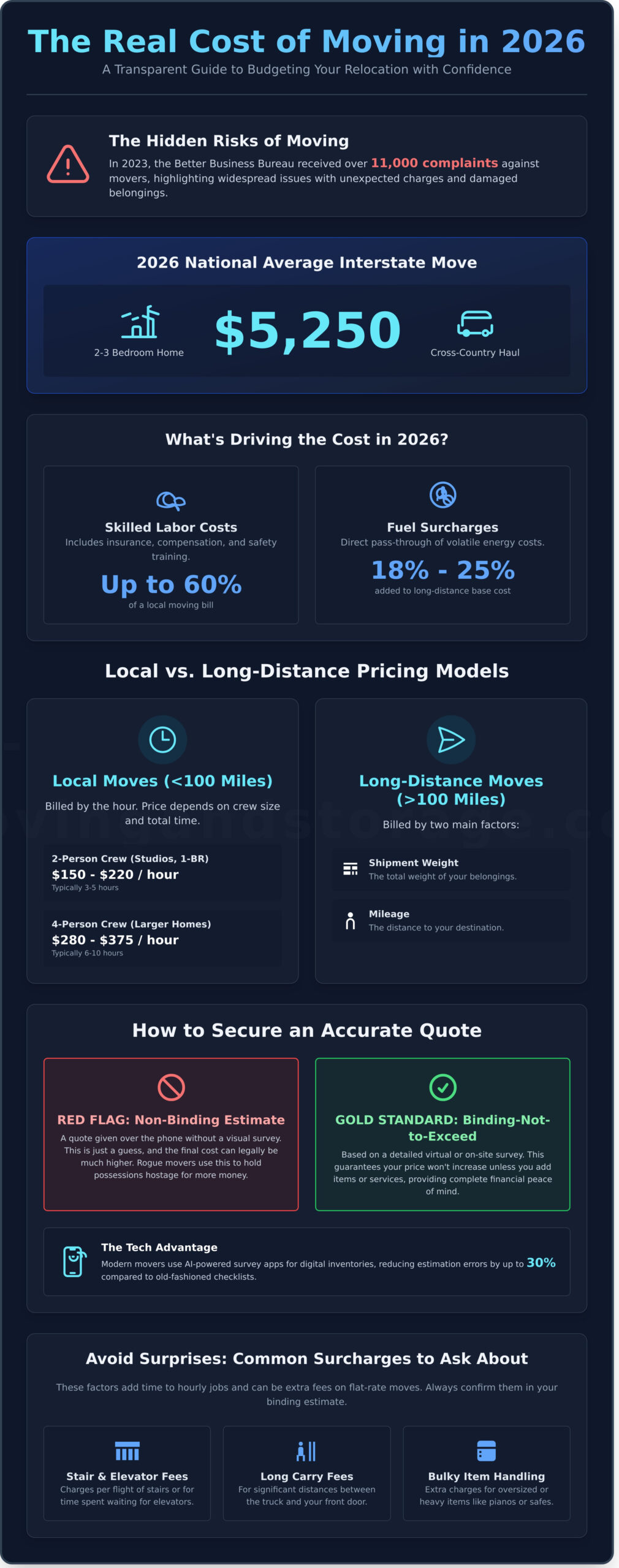
According to the Better Business Bureau, consumers filed over 11,000 complaints against moving companies in 2023, many related to unexpected charges and damaged goods. It’s no wonder that budgeting for a move can feel like navigating a minefield. You’re worried about confusing quotes, the shock of hidden fees for stairs or heavy items, and the risk of choosing an unreliable company for your fresh start.
That’s why we created this transparent guide. Our goal is to give you a clear, professional answer to the critical question: how much do movers cost 2026? We want you to plan your relocation with absolute confidence. In the sections below, we’ll break down average hourly and flat-rate pricing for every home size, from a local Florida move to a cross-country haul. You’ll learn exactly how to spot and avoid those costly surprise charges before you sign anything.
Key Takeaways
- Discover the key economic factors influencing 2026 moving estimates, allowing you to anticipate price shifts and plan your budget more effectively.
- Receive a clear breakdown of how much do movers cost 2026, comparing typical hourly rates for local moves against pricing structures for long-distance relocations.
- Accurately compare a professional move against a DIY approach by uncovering the “hidden costs” of renting a truck, from fuel and insurance to your own time.
- Learn to identify common surcharges, such as stair fees or bulky item handling, to ensure your final moving bill has no surprises.
Understanding the 2026 Moving Market: Why Costs Are Shifting
Planning a move in 2026 requires a clear understanding of a dynamic market. The price you’ll pay isn’t just about distance and the weight of your belongings; it’s a reflection of broader economic trends, labor conditions, and technological advancements. An accurate budget starts with knowing what factors are driving costs. From fuel prices to the methods used for your initial quote, every detail matters. This guide breaks down the key variables so you can confidently prepare for your relocation.
The 2026 Economic Landscape for Relocation
Several core economic factors directly influence your final moving bill. Based on projections from the American Moving & Storage Association’s 2024-2025 data, the 2026 National Moving Average for an interstate move is estimated at $5,250 for a 2-3 bedroom home. This figure is heavily impacted by two primary costs:
- Fuel Surcharges: With diesel prices projected by the U.S. Energy Information Administration to remain volatile, expect fuel surcharges to add between 18% and 25% to the base cost of long-distance hauls. This fee is a direct pass-through of transportation energy costs.
- Skilled Labor Costs: A professional mover’s hourly rate covers more than just heavy lifting. It includes comprehensive liability insurance, worker’s compensation, and ongoing safety training required by the Department of Transportation. These essential protections account for up to 60% of a local moving bill.
While these numbers provide a baseline, your specific quote will depend on the services you need. The rise of technology, however, is bringing new levels of precision to the quoting process. Professional movers increasingly use AI-powered survey apps to create a digital inventory of your home, a method that reduces estimation errors by up to 30% compared to old-fashioned checklists. This accuracy is vital when figuring out how much do movers cost 2026. Unfortunately, this same market also allows “rogue movers” to thrive. These unlicensed operators exploit uncertainty by offering rock-bottom phone quotes, only to hold a customer’s possessions hostage for hundreds or thousands of dollars more on moving day.
Transparency vs. Low-Ball Estimates
A quote given over the phone without a visual survey is no longer a reliable benchmark; it’s a significant red flag. In 2026, the distinction between a binding and non-binding estimate is critical. A non-binding estimate is a guess, and the final cost can legally be much higher. A binding-not-to-exceed estimate, the industry gold standard, guarantees your price won’t increase unless you add items or services. Understanding this difference is key to knowing what a professional moving company is legally obligated to provide. At All American Moving and Storage, we eliminate guesswork. Our certified estimators conduct a detailed virtual or on-site survey to provide a binding, written estimate. This ensures the price you see is the price you pay, offering complete financial peace of mind and protecting you from unexpected costs.
Average Moving Cost Breakdown by Home Size and Distance
Understanding how much do movers cost in 2026 begins with one key distinction: are you moving locally or across the country? The pricing models for these two scenarios are fundamentally different. A local move, typically defined as any relocation under 100 miles, is almost always billed by the hour. A long-distance move, however, is a more complex calculation based on the total weight of your belongings and the mileage to your destination. Knowing which category your move falls into is the first step toward building an accurate budget.
The national average moving costs provide a useful benchmark, but your final price will be unique. For local moves, the number of movers on your crew directly impacts the hourly rate. A standard 2-person crew, ideal for smaller apartments, is projected to cost between $150 and $220 per hour in 2026. For larger homes requiring more efficiency, a 4-person crew will run between $280 and $375 per hour. For extensive 3+ bedroom homes or complex estates, many professional moving companies provide a flat-rate price after a detailed in-home survey. This binding quote offers cost certainty and prevents unexpected charges on moving day.
Local Moving Costs: The Hourly Reality
A skilled moving crew works efficiently to minimize your hourly cost. A studio or 1-bedroom apartment move typically takes a 2-person crew between 3 to 5 hours. A 2-3 bedroom home often requires 6 to 10 hours of professional labor. However, certain logistical challenges will increase this time. These factors include:
- Stairs and Elevators: Navigating multiple flights of stairs or waiting for residential elevators adds significant time.
- Long Carries: The distance from your door to the moving truck. A 100-foot carry takes much longer than a 20-foot one.
- Disassembly/Reassembly: Time spent taking apart and rebuilding furniture is billable.
Long-Distance Moving: Mileage and Weight
For moves over 100 miles, the question of how much do movers cost in 2026 shifts from time to two primary factors: weight and distance. Your quote will be based on a certified weigh-in of your shipment. For example, the contents of an average 3-bedroom house weigh approximately 7,500 pounds. Your total cost will also be impacted by services like Full Value Protection insurance, which offers comprehensive coverage for your belongings and is a worthwhile addition for peace of mind. Finally, consider if you need a dedicated truck, which is faster but more expensive, versus a consolidated shipment, which is more economical but has a wider delivery window.
The variables can feel complex. The most reliable way to determine your exact moving budget is to request a detailed moving estimate from a certified professional. A transparent quote will break down every charge, ensuring you have a clear financial picture before your move begins.
Professional Movers vs. DIY: Evaluating Value Beyond the Price Tag
The initial sticker price of a rental truck can seem appealing, but it rarely reflects the true cost of a do-it-yourself move. A comprehensive analysis reveals that the convenience, safety, and efficiency of professional movers often provide superior value. When you ask how much do movers cost 2026, it’s critical to compare their all-inclusive quote against the total expense, effort, and risk of going it alone.
A DIY move requires you to become a logistician, a packer, and a manual laborer all at once. This approach trades a single, predictable cost for multiple, often unexpected, expenses in both time and money. Let’s break down the real comparison.
The Real Cost of a Rental Truck
That advertised $39.95 daily rate is just the beginning. The final bill is often three to four times higher once you account for mandatory additions. For a typical 50-mile local move in a 16-foot truck, your actual costs can quickly escalate:
- Mileage Fees: At an average of $1.19 per mile, a 50-mile trip adds an immediate $59.50.
- Fuel Costs: A loaded moving truck gets about 8 miles per gallon. With projected 2026 fuel prices around $4.50 per gallon, you’ll spend at least $28 to refuel.
- Equipment Rentals: You can’t move heavy furniture without tools. Expect to pay around $12 per day for a utility dolly and another $20 for a dozen protective moving blankets.
- Insurance and Liability: Basic rental insurance, which can cost $25 per day, often only covers damage to the truck itself. Any damage to your personal belongings during transit is your own responsibility, a risk many homeowners’ policies do not cover.
Suddenly, that $40 truck rental becomes a $170+ expense before you’ve even factored in the value of your own time and physical labor.
The Full-Service Advantage
Hiring a professional moving company transforms the process from a stressful ordeal into a managed project. The value is measured not just in dollars, but in safety, efficiency, and security. Skilled teams bring expertise that a DIY mover simply cannot replicate.
Our professional packers, for example, are trained to maximize space and ensure safety. They use specialized techniques to reduce the number of boxes needed by up to 20%, which can directly lower material and transportation costs. What might take you and a friend two full days (a total of 32 labor-hours) to pack and load, a skilled three-person crew can typically accomplish in just four to five hours. That’s a time saving of over 80%.
Most importantly, a licensed moving company provides financial protection. Unlike the limited liability of a truck rental, professional movers are regulated and must offer valuation coverage for your goods. Understanding your consumer protection and moving rights is a key step in any move, as it ensures you are covered if an accident occurs. This peace of mind is perhaps the most valuable asset a professional service provides, allowing you to focus on your new beginning instead of worrying about logistics and potential damage. The final calculation for how much do movers cost 2026 should always include this invaluable layer of security.
Navigating Hidden Fees and Regional Florida Moving Variables
Your initial moving estimate provides a solid baseline, but several factors can influence the final bill. A professional moving company is transparent about these potential costs from the start. Understanding these variables is essential for anyone trying to accurately budget for how much do movers cost 2026, especially within Florida’s unique market.
Unexpected charges often arise from logistical challenges specific to your property or timing. From navigating tight suburban streets to managing settlement date changes, a clear-eyed view of potential surcharges and regional pressures ensures your moving day is efficient and financially predictable. Before you sign a contract, confirm your mover has accounted for these possibilities.
Surcharges You Should Know
Beyond the standard labor and transportation, certain conditions require specialized handling and equipment, which come with additional fees. These are not hidden costs but charges for non-standard services. A dependable mover will identify and include them in your binding estimate.
- Bulky & Specialty Items: Standard moving rates don’t cover oversized or delicate items. Expect fees ranging from $150 to $400 for moving a standard upright piano or a three-piece slate pool table, which require specific equipment and skilled handling.
- Long Carry & Stair Fees: If the moving truck must park more than 75 feet from your front door, a “long carry” fee may apply, typically billed per-hour or as a flat rate ($75-$125). Similarly, navigating multiple flights of stairs, usually more than one, can add a fee of $50-$100 per flight.
- Shuttle Service: In communities with narrow roads or restricted access, like many in Weston or Davie, a 53-foot semi-truck cannot reach your home. A smaller shuttle truck is needed to transfer your belongings, a service that can cost between $300 and $600.
- Storage-in-Transit (SIT): If your new home isn’t ready due to a closing delay, SIT provides a temporary storage solution. This service involves unloading items into a secure facility and reloading them for final delivery, often incurring additional handling fees on top of monthly storage costs, which average $150 per month for a 10’x15′ space in Broward County.
Moving in Florida: Regional Price Drivers
Florida’s climate and population patterns create distinct challenges that directly impact moving logistics and costs. The timing of your move and local conditions are just as important as the size of your home. For example, scheduling a move in Broward County requires a deep understanding of local traffic, as a simple trip on I-595 can take 20 minutes at 11 AM but over an hour at 5 PM. For hourly moves, that difference directly impacts your final bill.
The “Snowbird” season, running from October through April, creates peak demand for moving services. During these months, availability is limited and rates can increase by up to 25% compared to the summer off-season. Conversely, moving during hurricane season (June 1 – November 30) requires a moving partner with a documented contingency plan for securing your items in the event of a storm.
Finally, always verify your mover is legally compliant. Any company performing moves within Florida must be registered with the Florida Department of Agriculture and Consumer Services (FDACS) and display their IM (Intrastate Mover) number. All American Moving and Storage is fully licensed and insured (FDACS Reg. No. IM2222), giving you complete peace of mind. For a detailed estimate that considers all these local variables, request a free, no-obligation quote from our certified moving consultants today.
Securing an Accurate Quote with All American Moving And Storage
Understanding the factors that influence moving prices is the first step. The final step is getting a firm, reliable quote you can build your budget around. At All American Moving And Storage, we’ve built our reputation on transparent pricing and a professional process designed to eliminate surprises. From your first call to the final box, our team provides a clear, dependable path for your relocation.
Our process begins with a comprehensive assessment of your specific needs. We don’t use generic online calculators that provide vague estimates. Instead, we offer a detailed in-home or virtual consultation. During this assessment, our skilled moving coordinator will survey your inventory, identify specialty items like pianos or antiques, and evaluate access points at both your current and future locations. This meticulous approach ensures the quote we provide is not just a guess, but a precise calculation based on the actual scope of your move.
The Benefits of a Local, Family-Owned Partner
As a family-owned Florida business, our accountability is to you, not a distant corporate office. When you call us, you speak directly with our local team. This direct line of communication allows for customized solutions, from full-service packing to secure, private storage at our Davie facility. We understand the unique challenges of relocating within the state and provide the dedicated service you deserve. You can learn more in our Guide to Stress-Free Local Moving in Florida.
To get the most accurate estimate and truly understand how much do movers cost 2026 for your specific situation, preparation is key. A well-prepared customer receives a faster, more precise quote. Before your consultation, take these steps:
- Finalize Your Inventory: Decide which items you are moving, selling, or donating. An accurate inventory is the foundation of an accurate price.
- Note Special Items: Make a list of anything that requires special handling, such as oversized furniture, fragile artwork, or heavy equipment.
- Check Building Access: If you’re moving into or out of an apartment or condo, confirm any moving day restrictions, elevator reservations, or specific insurance requirements from the building management.
- List Your Questions: Have your questions ready for our coordinator regarding insurance, packing materials, and scheduling.
Once your quote is finalized, you can lock in your rate. Planning a move for 2026 means booking early is your best strategy to secure your preferred date and avoid potential price increases. Answering the question of how much do movers cost 2026 becomes simple once you have a binding estimate from a trusted partner.
Ready to Move? Your Next Steps
Taking the next step is straightforward. You can schedule your free, no-obligation moving estimate by calling our office or filling out the simple form on our website. To ensure a smooth process, have any relevant building or HOA moving guidelines on hand. Our team is ready to provide you with a detailed, competitive quote that reflects our commitment to professional, reliable service. Don’t wait to secure your 2026 moving date.
Get Your Free Moving Quote Today
Secure Your 2026 Moving Budget Today
Planning your move means understanding the costs. As we’ve detailed, factors like your home’s size, the moving distance, and the specific services you need all play a major role. While average prices provide a baseline, the only way to truly know how much do movers cost 2026 for your unique situation is with a professional estimate. Don’t let hidden fees or regional Florida variables catch you by surprise; get a clear and accurate picture from the start.
Instead of guessing, get a firm, reliable number from a team you can trust. As a family-owned and insured company serving Weston, Davie, and all of South Florida, we provide complete peace of mind. Our skilled professionals offer expert handling of specialized items, including antiques and pianos, ensuring your valuables are protected every step of the way. Take the next step with confidence.
Get a Free, Reliable Moving Quote from All American Moving and Storage and let our experts handle the details. It’s time to make your 2026 move smooth and stress-free.
Frequently Asked Questions About Moving Costs
How much does it cost to move a 3-bedroom house in 2026?
The cost to move a 3-bedroom house in 2026 is projected to range from $1,800 to $3,000 for a local move under 100 miles. For a long-distance, state-to-state move, the price increases to between $6,500 and $9,000. These figures are influenced by the total weight of your belongings, the precise mileage, and any additional services like packing. To understand exactly how much do movers cost 2026 for your specific needs, a detailed, in-home estimate is essential.
Is it cheaper to move on a weekday or a weekend?
Yes, moving on a weekday is significantly cheaper than moving on a weekend. You can typically save between 20% and 30% by scheduling your move between Monday and Thursday. Demand for moving services peaks on Fridays and Saturdays, which drives rates up. For the best prices, aim for a Tuesday or Wednesday move, especially if you can book outside of the peak season from May to September. Planning ahead helps secure these lower-cost dates and ensures availability.
Do moving companies charge extra for stairs or elevators?
Yes, professional moving companies typically assess extra fees for handling stairs or long distances from the truck to your door. These are often called “stair fees” or “long carry fees” and compensate for the additional time and physical labor required. The charge is usually a flat fee, around $50 to $75 per flight of stairs. A reliable mover will always identify and include these charges in your written estimate so you aren’t surprised by the final bill.
What is the average hourly rate for movers in Florida?
In 2026, the average hourly rate for professional movers in Florida is expected to be between $150 and $225. This rate typically includes a two-person crew and one moving truck. It also covers the use of essential equipment like moving blankets and dollies. Rates can be about 10% higher in major metropolitan areas like Miami compared to smaller cities. Always confirm exactly what services and protections are included in the quoted hourly rate before booking.
Should I tip my movers, and how much is standard in 2026?
Tipping your movers isn’t required, but it is a standard practice to show appreciation for excellent service. A common tip in 2026 is 15-20% of the total cost of the move, divided among the crew members. Alternatively, you can tip a flat amount per person; $40 to $60 per mover is considered generous for a full-day move. You can give the total tip to the crew’s foreman, who will ensure it’s distributed fairly among the team.
What is the difference between a binding and non-binding estimate?
A binding estimate is a contract that guarantees a fixed price for your move, which will not change unless you add more items or request services not on the original agreement. In contrast, a non-binding estimate is a company’s best guess of the final cost; your actual bill could be higher or lower based on the final weight of your shipment. For the greatest peace of mind, you can ask for a “binding not-to-exceed” estimate, which means you’ll never pay more than the quoted price.
How much does professional packing service typically add to the cost?
Professional packing services can add between $500 and $2,500 to your total moving cost for an average 2 to 3-bedroom home. The price is based on the amount of items and the cost of materials like boxes and bubble wrap. Some companies charge an hourly rate, often between $60 and $80 per packer. While it’s an added expense, this service ensures your belongings are packed securely by trained professionals, saving you dozens of hours of work and stress.
Can I save money by providing my own moving boxes?
Yes, you can save a significant amount of money by providing your own moving boxes. Packing materials can account for 10% to 15% of a full-service move’s cost, so sourcing your own boxes can save you between $150 and $400 for an average home. Just ensure any used boxes you acquire are sturdy, clean, and completely dry. Using damaged or weak boxes puts your belongings at risk, potentially costing you more in the long run if items break during transit.