
Would you leave your mahogany dining set or leather armchair sitting on a Fort Lauderdale sidewalk for 48 hours? In South Florida, storing items in a standard unit is often just as risky. With local humidity levels averaging 74% year round, moisture is a constant threat to your property. Choosing climate controlled storage Fort Lauderdale ensures your belongings don’t fall victim to the $3,000 in restoration costs the average mold infestation requires. You’ve worked hard to acquire your valuables, and you deserve to know they’re sitting in a stable, professional environment.
We understand the stress of worrying about mildew or the confusion of navigating high Broward County prices. This guide will show you exactly why climate control is non-negotiable and how to distinguish it from simple temperature control. You’ll learn which items are most at risk and how to secure a reliable storage partner for 2026. By the end of this article, you’ll have a clear plan to keep your items in mint condition while avoiding the hidden costs of heat and humidity damage.
Key Takeaways
- Understand how South Florida’s high humidity and the “dew point trap” in standard units can cause irreversible condensation damage to your belongings.
- Learn the vital difference between temperature and climate controlled storage Fort Lauderdale to ensure your items are protected from both heat and moisture.
- Identify which high-risk household items require specialized care and how to categorize your valuables for maximum long-term safety.
- Discover the essential features to look for in a Broward County facility, including the logistical benefits of proximity to I-95 and the Turnpike.
- Find out how an integrated moving and storage approach provides professional “white glove” packing to simplify your entire relocation process.
The Fort Lauderdale Climate Factor: Why Standard Storage Fails
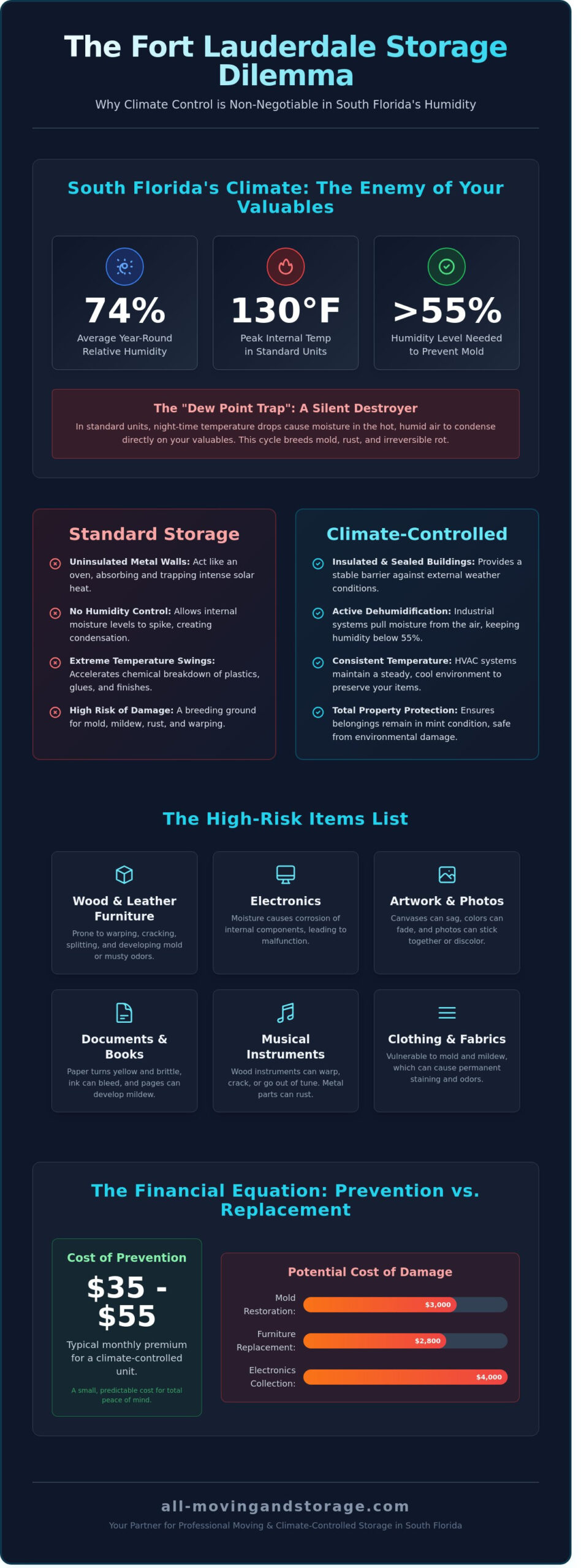
Fort Lauderdale is famous for its sun, but its humidity is the primary enemy of your stored property. Average relative humidity in Broward County stays around 74% year-round. During the peak of summer, these levels often hit 90% before noon. Selecting a basic unit without environmental regulation is a gamble that rarely pays off for residents of South Florida.
The “Dew Point” trap is a common reason for property loss in our region. When the temperature drops slightly at night, the air inside a metal box cannot hold its moisture. This causes internal condensation to form on the ceiling and walls. Before you decide on a facility, it helps to understand what self-storage is and how specialized climate controlled storage Fort Lauderdale systems prevent this cycle of moisture. Without active dehumidification, your unit becomes a breeding ground for rot.
Looking ahead to 2026, weather patterns in South Florida are becoming more volatile. Meteorologists predict a 15% increase in days exceeding 95 degrees compared to the 1990-2020 average. These extreme heat spikes accelerate the chemical breakdown of plastics, glues, and wood finishes. Standard units offer no protection against these rising thermal loads, making professional climate management a necessity rather than a luxury.
The financial math is clear when you compare storage premiums to replacement costs. A climate-controlled unit typically costs between $35 and $55 more per month than a standard drive-up stall. However, replacing a $2,800 mahogany dining set or a $4,000 collection of electronics is a much higher price to pay. We believe in protecting your investment from the start so you don’t face the heartbreak of opening a unit to find ruined memories.
The Science of Humidity and Mold in South Florida
Mold spores are opportunistic; they activate the moment humidity levels cross the 60% threshold. In Broward County, this happens nearly every single day. Inside a standard outdoor unit, the “Micro-Climate” effect takes hold. These units act like industrial ovens, and internal temperatures often climb to 130 degrees Fahrenheit by 2:00 PM. To ensure safe long-term storage, sensitive items must be kept in an environment where relative humidity never exceeds 55% at any time.
Standard vs. Climate Controlled: A Local Perspective
There is a massive physical difference in how these facilities are built. Standard units are often just garage-style stalls with thin metal walls and roll-up doors. In contrast, climate controlled storage Fort Lauderdale facilities are housed in insulated, multi-story buildings with central HVAC systems. Many renters think “ventilation” helps, but in Florida, vents just pull in more salty, wet air from the Atlantic.
Consider the case of a $3,200 Italian leather sofa. If you store this item in a non-controlled unit during the summer, it will likely show visible white mold growth and a permanent “musty” odor within 90 days. The structural glues in the frame will also begin to soften, leading to warping. Our professional-grade units prevent these issues by maintaining a steady, cool environment 24 hours a day.
What is Climate Controlled Storage? More Than Just Air Conditioning
Many people assume that climate control is just another name for air conditioning. It isn’t. While a standard air conditioner focuses on lowering the temperature, true climate control involves the simultaneous management of temperature and relative humidity. In a coastal city like Fort Lauderdale, where humidity levels often exceed 80% during the summer months, simply cooling the air can be insufficient. Cold air holds less moisture than warm air, so if a system only cools without actively dehumidifying, it can actually cause condensation to form on your belongings. This leads to mold, rust, and structural damage.
The distinction between temperature controlled and climate controlled units matters for your wallet and the safety of your property. Temperature-controlled units typically use basic HVAC systems to keep the air within a broad range, often between 60°F and 80°F. However, they don’t always monitor moisture. Professional climate controlled storage Fort Lauderdale facilities go a step further by utilizing industrial-grade dehumidifiers alongside HVAC systems. These machines work 24/7 to pull gallons of water from the air every day, ensuring your items stay dry and stable. This level of care follows professional guidelines for preserving sensitive items like fine art, vintage documents, and delicate musical instruments.
The ideal range for a secure facility is keeping units between 55°F and 85°F with humidity levels strictly below 55%. Maintaining this balance prevents wood from warping, leather from cracking, and electronics from corroding. If you’re preparing for a move, choosing safe, private storage ensures your items remain in the same condition as the day they were packed. Our team manages every detail to provide a reliable environment for your most valued possessions.
Humidity Regulation: The Silent Protector
Cooling the air isn’t enough if the moisture content remains high. High humidity is the primary cause of mold growth on upholstered furniture and yellowing on important papers. Professional facilities use digital hygrometers to monitor air quality every hour. These sensors trigger dehumidifiers the moment moisture levels rise. To maintain this stable internal environment, buildings use specialized R-19 or R-30 insulation. This thick barrier creates a thermal break that prevents the intense Florida heat from seeping through the walls, ensuring the mechanical systems don’t have to overwork to keep your unit safe.
Air Filtration and Dust Control
Indoor units offer a secondary layer of protection through advanced air filtration. These facilities use high-efficiency MERV 11 filters to trap dust, pollen, and debris before they settle on your property. This is vital for long-term clothing storage and sensitive electronics, where dust accumulation can cause overheating or permanent staining. Because climate controlled storage Fort Lauderdale units are located inside a finished building with restricted access, they stay significantly cleaner than outdoor drive-up lockers. You get a dust-free space and an extra layer of security that protects against pests and environmental contaminants. It’s a professional solution for anyone who values cleanliness and long-term preservation.
The “Must-Protect” List: Items That Require Climate Control
Storing your belongings in South Florida involves more than just finding a locked room. The local environment presents a constant challenge to physical materials. Standard units often reach internal temperatures exceeding 100 degrees Fahrenheit during July and August. When you combine this heat with relative humidity levels that frequently stay above 85%, your items face a high risk of permanent damage. Using climate controlled storage Fort Lauderdale provides a stable environment that keeps temperatures between 65 and 80 degrees and humidity levels near 50%.
You can categorize your inventory into risk levels to decide what needs protection. High-risk items include anything organic, electronic, or irreplaceable. Moderate-risk items might include plastics, treated metals, or seasonal decorations. To test an item’s vulnerability, use the “Sniff Test.” Organic materials like wood, paper, and natural fibers absorb ambient moisture. If an item can hold a scent or feel “damp” to the touch, it’s a primary candidate for climate control. Without it, these materials become the first to suffer from mold and structural breakdown.
Wood, Leather, and Antique Furniture
Solid wood is a porous, living material that reacts to its surroundings. In Fort Lauderdale, wood fibers expand as they soak up moisture from the heavy air. When the temperature drops or the air dries out, the wood contracts quickly. This cycle causes warping, joint separation, and deep cracks in expensive pieces. Leather furniture is equally sensitive. In non-controlled environments, leather suffers from “leather rot.” This happens when trapped moisture leads to fungal growth, causing the surface to peel or discolor. Protecting a family heirloom is a smart investment; one humid summer can ruin a dining set that stayed in perfect condition for 50 years.
Electronics, Media, and Documents
Modern electronics rely on intricate internal circuitry that is highly susceptible to corrosion. High moisture levels cause tiny silver and copper components to oxidize, which often leads to total hardware failure. Paper products face a different but equally destructive threat. Photographs can stick together in as little as 30 days when exposed to high heat. You should review scientific data on how temperature and humidity damage valuables to see how chemical reactions accelerate in the heat. For example, magnetic media like VHS tapes or older hard drives lose data integrity when temperatures exceed 90 degrees Fahrenheit. Documents will yellow and become brittle if the relative humidity stays above 60% for extended periods.
Clothing, Linens, and Upholstery
Fabric items are often the first to develop the “musty basement” smell associated with poor storage. In South Florida, this smell is actually a sign of active mildew. Humidity creates a perfect breeding ground for dust mites and silverfish, which feed on natural fibers like wool and silk. High-end fashion and wedding dresses require specific care to prevent the breakdown of delicate lace or the yellowing of white fabrics. If you store these in a standard unit, the damage is often irreversible. Choosing climate controlled storage Fort Lauderdale ensures your wardrobe stays fresh and ready to wear.
If you have a mix of items and a limited budget, use this prioritization list:
- Top Priority: Family photos, computers, musical instruments, and leather goods.
- Secondary Priority: Upholstered furniture, business records, and designer clothing.
- Lower Priority: Plastic bins, garden tools, and ceramic items.
Choosing the Right Storage in Fort Lauderdale
Selecting the right climate controlled storage Fort Lauderdale facility requires more than just checking a price tag. You need a location that balances accessibility with high-end protection. Facilities located within 3 miles of I-95 or the Florida Turnpike reduce transit time by an average of 18 minutes during peak afternoon traffic. This efficiency is vital when you’re managing a large move or need to make frequent visits to your unit. A convenient location ensures that your transition remains fast and dependable.
Security protocols must be multi-layered to be effective. High-tier facilities utilize 4K digital video surveillance and electronic gate access with unique user codes. This tracking ensures only authorized individuals enter the premises. Beyond the lock on your door, these systems provide a documented record of everyone who enters the property. It’s this level of detail that builds the trust necessary to store valuable family heirlooms or sensitive business documents.
Flexible terms are essential for a stress-free experience. Data from 2023 shows that 22% of storage users require units for less than 90 days due to home renovations or delayed closings. Choosing a month-to-month lease prevents you from paying for space you no longer need. Avoid long-term contracts that lock you into 12-month terms unless your timeline is certain. Professional facilities prioritize service by offering these adaptable options to meet your specific residential or commercial needs.
Facility Inspection Checklist
Walk the halls before signing a contract. Look for signs of past water intrusion; discolored concrete or peeling paint near the floor often indicates previous flooding or roof leaks. Professional managers should provide clear answers about their HVAC redundancy. Ask if they have backup generators to maintain temperatures during the 48-hour outages common after tropical storms. Observe the 10-day pest control logs to ensure the environment remains sterile and safe for your furniture.
Packing for Climate Controlled Success
Ditch the cardboard. In South Florida, cardboard boxes lose 30% of their structural integrity within 4 months because they absorb environmental moisture. Heavy-duty plastic bins provide a waterproof barrier and stack more securely. When you use climate controlled storage Fort Lauderdale, you must also follow the Airflow Rule. Leave 3 inches of space between your belongings and the back wall. This allows the system to pull heat away from your items effectively and prevents stagnant air pockets.
For high-value assets like antiques or fine art, specialized protection is a requirement. Our team provides professional packing services to ensure your items are crated with the correct materials for long-term preservation. Proper packing combined with the right facility creates a total safety net for your property.
Ready to secure your belongings in a professional environment? Contact All American Moving and Storage today to get a free quote and experience a seamless move.
All American Moving & Storage: Your Integrated Solution
Relocating involves more than just driving boxes from one point to another. It requires a synchronized strategy, especially when your new home isn’t ready for immediate occupancy. Choosing a mover that provides high-end climate controlled storage Fort Lauderdale residents depend on eliminates the logistical nightmare of coordinating multiple vendors. You won’t have to manage separate contracts or worry about your belongings sitting in a humid truck during a scheduling gap. We provide a bridge between your old residence and your new South Florida address, ensuring a smooth transition that protects your investment.
Our “White Glove” service sets us apart from standard moving companies. We don’t just stack boxes; we prepare your items for the specific environment of long-term storage. Our team uses 3-ply corrugated cardboard for fragile items and custom-fit crates for high-value artwork or mirrors. For upholstered furniture, we apply 4-mil thick industrial stretch wrap to prevent dust accumulation and moisture penetration. This meticulous preparation ensures that when your items finally arrive at your new Fort Lauderdale home, they look exactly as they did when they left your old one.
The Davie and Weston facilities we operate are designed for maximum security and environmental stability. We maintain these spaces at a consistent temperature range between 72 and 78 degrees Fahrenheit. This specific calibration is vital because South Florida humidity often exceeds 90 percent, which can cause wood to warp or mold to grow on fabrics within 48 hours. Our facilities feature 24-hour video surveillance and restricted access protocols, providing a private environment that typical self-storage units can’t match.
Seamless Moving and Storage Integration
We eliminate the “double move” by transporting your items directly from your home into our secure, vaulted storage units. Traditional self-storage requires you to unload a truck and pack a unit yourself, which doubles the risk of accidental damage. Our professional crew handles the entire process, using specialized equipment to move heavy pieces safely. We utilize a digital inventory management system that assigns a unique tracking number to every item. You’ll receive a detailed manifest, so you always know exactly what’s in our care. Ready to start? Get a Free Quote for Moving and Storage today.
Family-Owned Reliability in South Florida
All American Moving And Storage has served the Fort Lauderdale community since 1998. Unlike national franchises that rely on distant call centers, we’re a local, family-owned business. When you call us, you speak directly with a South Florida expert who understands the local climate and traffic patterns. This local expertise translates to better service and more accurate arrival windows. We’re fully insured and licensed, giving you peace of mind that your property is protected by a team that truly cares about its reputation in the neighborhood. You can reach out to our team at any time for direct updates on your stored belongings.
Protect Your Valuables from the South Florida Heat
Fort Lauderdale’s tropical environment brings humidity levels that frequently exceed 70 percent. This creates a high risk for mold, mildew, and warping in standard units that lack environmental regulation. You’ve seen how essential it’s to protect high-value items like electronics, leather, and wood furniture from these harsh coastal conditions. Investing in climate controlled storage Fort Lauderdale is the only way to ensure your possessions remain in a stable, temperature-regulated environment throughout 2026 and beyond.
All American Moving & Storage provides a professional, integrated solution to these environmental challenges. We’re a family-owned and fully insured company that utilizes specialized packing for high-humidity environments to keep your goods dry. With our A+ rated local service in Weston and Davie, you can trust that your move is handled by certified experts who prioritize safety. Don’t leave your legacy to chance when professional protection is just a click away. Get Your Free Moving & Storage Quote Today and enjoy the peace of mind that comes with dependable expertise.
Frequently Asked Questions
Is climate-controlled storage worth the extra cost in Fort Lauderdale?
Yes, climate-controlled storage is essential in Fort Lauderdale because average humidity levels exceed 70 percent year-round. High humidity causes mold to grow on fabric and wood in less than 48 hours. Paying the 25 percent premium for a protected unit prevents thousands of dollars in property damage. It ensures your belongings stay in the same condition as when you packed them. Our clients find the peace of mind worth every penny.
What is the difference between temperature-controlled and climate-controlled storage?
Climate-controlled storage manages both temperature and humidity, while temperature-controlled units only regulate the heat. In South Florida, managing humidity is the priority. A temperature-controlled unit might stay at 75 degrees but still have 80 percent humidity. Professional climate controlled storage Fort Lauderdale facilities use industrial dehumidifiers to keep moisture levels between 30 and 50 percent. This dual regulation provides the highest level of safety for your sensitive valuables.
How much does climate-controlled storage cost in Fort Lauderdale in 2026?
In 2026, a standard 10×10 climate-controlled unit in Fort Lauderdale averages 185 dollars per month. Prices typically range from 160 dollars to 210 dollars depending on the facility’s location and security features. This represents a 15 percent increase from 2024 rates due to rising utility costs and local demand. We recommend booking your space 30 days in advance to lock in these competitive rates and ensure availability during peak moving seasons.
Can I store my car in a climate-controlled unit in South Florida?
You can store a car in specialized climate-controlled units, though most standard indoor facilities prohibit motorized vehicles due to strict fire codes. Dedicated auto storage facilities in Broward County offer 72-degree environments that prevent leather dashboards from cracking and gaskets from drying out. These units usually start at 350 dollars per month for a single vehicle. Always check specific facility insurance requirements and fuel tank regulations before booking your vehicle’s spot.
Do I need climate control for a short-term move of only 30 days?
Yes, you need climate control even for 30 days because Florida’s mold spores can activate within 24 to 48 hours of exposure to high humidity. A single summer afternoon in a standard metal container can reach 120 degrees. Using climate controlled storage Fort Lauderdale for your short-term move guarantees that your mattresses and electronics don’t suffer irreversible heat damage. It’s a small investment to protect your property during a fast 30-day transition.
What happens if the power goes out at a climate-controlled facility during a hurricane?
Most professional facilities use backup diesel generators that activate within 30 seconds of a power failure to maintain air circulation. Modern concrete storage buildings are designed with R-30 insulation values, which helps maintain stable internal temperatures for up to 72 hours without power. Our facility protocols include 24-hour monitoring to protect your items during major storm events in South Florida. This reliable infrastructure keeps your belongings safe even when the local grid fails. This same need for reliability applies to residential systems, which is why having a provider for emergency AC repair Treasure Coast is a critical part of any homeowner’s preparedness plan.
Are there specific items that don’t need climate control in Florida?
You don’t need climate control for items made of plastic, glass, or high-grade metals. Plastic storage bins, glass dishware, and outdoor patio furniture built from aluminum can withstand the 90-degree heat of a standard unit without warping. Approximately 15 percent of household goods fall into this category. However, we suggest climate control for any item containing adhesives, paper, or natural fibers. This approach prevents the degradation of glue and the yellowing of important documents.
How do I calculate what size climate-controlled unit I need for a 3-bedroom house?
A 3-bedroom house typically requires a 10×20 or 10×25 climate-controlled unit, providing 200 to 250 square feet of space. This size accommodates roughly 1,200 cubic feet of furniture and boxed items. Our expert team recommends inventorying your large appliances first, as they take up 30 percent of the floor plan. Using a professional 10×20 unit ensures you have walking paths to access your belongings safely while keeping everything organized and protected from the elements.