
It’s Friday afternoon at 2:00 PM, your entire life is packed into a truck, and you just received a call that your new home’s closing is delayed by 10 days. This sudden gap leaves your belongings in limbo and your stress levels at a breaking point. Finding reliable short term storage for moving is the only way to protect your furniture from the 90% Florida humidity while you wait for your new keys.
The types of facilities and what they offer can vary significantly depending on your location. While this guide focuses on protecting household goods in Florida’s climate, other areas may have different priorities. For instance, a family-run facility like 66 & 85 Storage in Colorado provides secure outdoor options for vehicles and other large items, showing the range of services available in the self-storage industry.
We understand that a moving delay feels like a crisis. It’s especially difficult when you’re worried about the safety of your high-value items. You deserve a transition that doesn’t involve the physical exhaustion of unloading and reloading your life multiple times. This guide will show you how to secure flexible, climate-controlled solutions that bridge the gap between homes for 30 to 90 days. We’ll explore how professional storage keeps your move on track, protects your investment, and provides the peace of mind you need during a complex Florida relocation.
Key Takeaways
- Learn how to effectively bridge the “moving gap” when your closing dates and lease starts don’t perfectly align.
- Compare the costs and benefits of self-storage, portable units, and full-service options to find your ideal fit.
- Discover how integrated short term storage for moving eliminates the “labor tax” and reduces the risk of damage caused by moving items twice.
- Identify which household items require climate-controlled protection to survive South Florida’s intense heat and humidity.
- Simplify your relocation by leveraging local expertise and secure, professional storage solutions tailored for the South Florida region.
What is Short-Term Storage for Moving and Why Do You Need It?
Short-term storage is a targeted solution for transitions lasting 90 days or less. It acts as a secure bridge between your old residence and your new home. While many people understand what self-storage is in a general sense, short-term storage for moving is a specialized service designed for speed and accessibility. It provides a reliable space for your belongings when your move-in date doesn’t perfectly align with your move-out date.
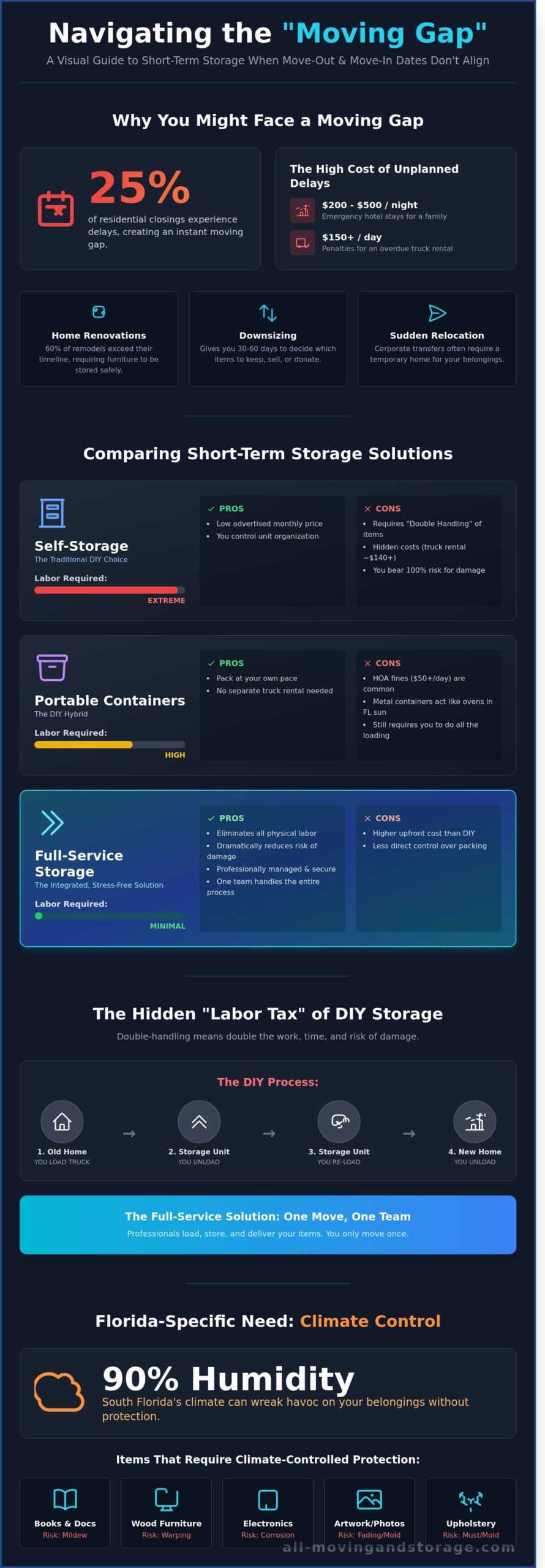
The “Moving Gap” is a common hurdle for homeowners and renters alike. Real estate data shows that approximately 25% of residential closings experience a delay of at least 24 hours. These small windows of time create significant logistical hurdles. You can’t keep a loaded moving truck parked on a public street indefinitely, and most rental contracts require you to vacate by noon on the last day of the month. Short-term storage for moving solves this by offering a professional holding area for your items.
Common scenarios where this service becomes essential include:
- Home Renovations: A 2023 industry report found that 60% of home remodels exceed their initial timeline by at least 14 days. Storage keeps furniture safe from dust and debris during construction.
- Downsizing Transitions: When moving into a smaller space, you may need 30 to 60 days to decide which items to sell or keep.
- Sudden Relocation: Corporate transfers often happen in under 30 days, leaving little time to find a permanent residence.
Traditional self-storage isn’t always the best fit for an active move. Standard facilities often require long-term commitments or lack the professional loading docks needed for large moving trucks. Professional moving storage is managed by experts who ensure your items are handled with care and stored in a way that makes final delivery fast and efficient.
The Real Estate Timing Conflict
A 24-hour delay in a bank wire or a failed final walkthrough can derail a DIY move instantly. Using storage as a buffer reduces moving day stress by removing the “all or nothing” pressure of a single afternoon. It also offers a clear financial benefit. Emergency hotel stays for a family of four can cost $200 to $500 per night. When you add the $150 daily penalty for an overdue truck rental, the costs of a timing conflict escalate quickly. A secure storage unit is a much more affordable insurance policy against these unpredictable delays.
Temporary Storage vs. Long-Term Warehousing
Pricing structures for temporary storage are built for flexibility. While long-term warehousing often involves yearly contracts and limited access, short-term options usually operate on a monthly or even weekly basis. You pay for the exact duration you need. Identify when “short-term” is likely to become “long-term” by tracking your construction permits or closing milestones. If your gap extends past the 90-day mark, it’s often more cost-effective to transition into a standard monthly warehousing agreement. Our team provides the skilled guidance needed to help you choose the most dependable plan for your specific timeline.
Comparing Short-Term Storage Solutions: Self-Storage vs. PODS vs. Full-Service
Choosing the right short term storage for moving depends on your budget and how much physical labor you’re willing to handle. You have three primary paths. Each offers different levels of protection, cost structures, and accessibility. Making the wrong choice can lead to damaged furniture or unexpected fees that break your relocation budget.
Self-Storage Units: The Traditional Choice
Self-storage is often the first option people consider because of the low monthly sticker price. You can find 10×10 units for as little as $85 to $150 per month. This format gives you total control over how your items are stacked and organized. However, the labor is intensive. You’ll face “double-handling,” which means loading a truck at your house, unloading it at the facility, and then repeating the entire process when your new home is ready.
The hidden costs often surprise DIY movers. A truck rental advertised at $19.99 often balloons to $140 after adding mileage fees, fuel, and specialized insurance. You also bear 100% of the risk if an item breaks during transit or while you’re stacking the unit yourself.
Portable Containers (PODS/U-Box): The DIY Hybrid
Portable containers offer the convenience of packing at your own pace right in your driveway. This eliminates the need for a rental truck. While this sounds ideal, it presents specific challenges in South Florida. In residential areas like Weston or Davie, roughly 75% of homeowners associations have strict rules against leaving containers on the street or driveway for more than 48 hours. Violating these rules can result in daily fines of $50 or more.
Climate is another major factor. Florida sun can push the interior temperature of a steel container above 125 degrees Fahrenheit. This extreme heat can warp vinyl records, melt candle wax, or damage the internal components of sensitive electronics within just 4 hours of exposure. If you choose this route, ensure your container is moved to a climate-controlled warehouse quickly.
Full-Service Moving and Storage
Full-service storage is the most comprehensive option. Professional crews handle all the heavy lifting, inventory management, and transport. This is the safest method for high-value items like 9-foot grand pianos or 18th-century antiques. Professionals use specialized crating and heavy-duty padding that standard DIY kits don’t include. Before you hire a company, Know Your Rights and Responsibilities by reviewing federal guidelines for consumer protection.
While the upfront cost is higher than a locker, the total effort is significantly lower. Your items are inventoried with a 15-point checklist and placed into secure, private vaults. This eliminates the risk of “double-handling” damage because the items stay wrapped and protected until they reach your final destination. If you want a stress-free transition, you might request a professional storage quote to see how the costs compare to DIY options.
- Security: Full-service facilities typically feature 24/7 video monitoring and restricted access, whereas self-storage units often rely on a simple padlock.
- Accessibility: Self-storage allows daily access; full-service storage is best for those who don’t need to reach their items until delivery day.
- Labor: Professional crews save you approximately 12 to 20 hours of physical labor per move.
Selecting the right short term storage for moving requires balancing these factors against your specific timeline. If you have a 30-day gap between leases, the security of a professional warehouse often outweighs the perceived savings of a self-managed unit.
The Hidden Costs of Double-Handling: Why Integrated Storage Saves Money
Moving twice costs significantly more than moving once. When you opt for a DIY approach with a separate self-storage unit, you pay a “labor tax” in the form of your own time and physical exhaustion. For a standard 2,500-square-foot home in Florida, moving into a self-storage unit and then out again adds an extra 12 to 16 hours of heavy lifting. Integrated short term storage for moving eliminates this middle step. You load the truck once, and our professional team handles the logistics until your new home is ready for occupancy.
Every time a box is lifted or a sofa is pivoted, the risk of a drop or a crush increases. Industry data indicates that 65% of household goods damage happens during the transitions between the truck and the storage unit. Professional movers use vaulted storage to mitigate this specific risk. Instead of stacking items loosely in a garage-style unit where they might shift, we place your belongings into large, secure wooden vaults. A forklift moves the entire 7-foot by 5-foot vault into our climate-controlled warehouse. This means your furniture is only handled twice: once when it’s loaded at your curb and once when it’s delivered to your new address.
The efficiency of a single contract for both transportation and warehousing cannot be overstated. Managing two different companies leads to scheduling conflicts and finger-pointing if a delay occurs. With an integrated solution, you have one point of accountability. We manage the timeline, the truck, and the warehouse space. This streamlined approach reduces administrative overhead and ensures that your move stays on track without the need for multiple deposits or complex coordination between different vendors.
Inventory Management and Protection
Professional inventory management ensures nothing gets lost during your transition. Our team creates a detailed digital manifest of every item before it enters our facility. Unlike self-storage where items are often stacked without a clear record, our short term storage for moving utilizes a systematic tagging process. We keep your furniture in its original “blanket wrapping” for the duration of its stay. This heavy-duty padding stays on the item until it reaches your new living room, providing a continuous shield that self-storage units simply don’t offer. Furthermore, our professional liability coverage provides much higher protection levels than standard self-storage insurance policies.
Saving Time in the Moving Process
Efficiency is the hallmark of our straight-to-storage workflow. A family in Weston recently moved from a four-bedroom house to a temporary condo while waiting for their new build to finish in March 2024. By choosing integrated storage, they saved 19 hours of labor and avoided three separate truck rental fees. They didn’t have to drive back and forth to a facility or worry about returning a rental truck with a full tank of gas. We handled the heavy lifting, allowing them to focus on their family during a busy transition period. This professional approach turns a multi-day ordeal into a single, organized event.
Choosing a professional moving and storage partner is about more than just finding a place for your boxes. It’s about protecting your investment and reclaiming your time. By reducing the number of times your belongings are handled, you ensure they arrive at your new home in the same condition they left. Our secure, climate-controlled warehouse is ready to protect your items for as long as you need.
Florida-Specific Storage Needs: Climate Control and Security
South Florida’s climate presents unique challenges that can quickly ruin a household’s worth of belongings. If you’re searching for short term storage for moving in areas like Davie or Weston, you can’t treat storage as a simple “lock and leave” situation. The environment here is aggressive. Relative humidity levels in Broward County frequently exceed 85% during the summer months, creating a breeding ground for spores and structural degradation.
When you store items without environmental oversight, you’re risking permanent loss. Professional moving warehouses use industrial-grade dehumidification systems to pull gallons of water out of the air every day. This process prevents the “green fur” of mold from appearing on your items. Beyond mold, heat is a silent killer for adhesives and finishes. In a non-regulated unit, temperatures can climb 15 degrees higher than the outside air, melting the glues in your furniture or ruining the sensitive components in your home office setup.
Preventing Mold and Heat Damage
If you’re storing leather sofas or upholstered chairs, 90-degree days can cause permanent damage by trapping moisture within the fibers, leading to mold growth in as little as 48 hours. Professional storage facilities mitigate this by maintaining steady airflow and moisture barriers. Electronics are particularly vulnerable; high humidity causes internal corrosion on circuit boards before you even unpack them at your new home. Solid wood furniture is another high-risk category because it breathes. Rapid changes in Florida’s humidity cause wood to warp, swell, or crack, often ruining heirlooms in a single season. To ensure the longevity of your belongings, the ideal temperature range for Florida storage is between 68 and 78 degrees Fahrenheit with humidity levels kept below 55%.
Security Features to Look For
Security standards in the Davie and Weston area have evolved to meet high-end residential needs. You should prioritize facilities that offer 24/7 digital surveillance, multi-stage gated access, and modern fire suppression systems. However, the most critical security choice is the type of facility you select. There’s a significant difference between public self-storage and private moving storage. Public facilities allow high foot traffic, which increases the risk of theft or “unit hopping” from neighboring tenants. Private storage warehouses, managed by professional movers, restrict access to authorized staff only. This creates a closed-loop system where your items are inventoried, vaulted, and monitored without the general public ever entering the storage area. It’s a higher tier of protection that provides true peace of mind during a hectic move.
Florida storage providers also have specific insurance and valuation requirements. Under standard moving contracts, items are typically covered at a basic valuation of $0.60 per pound. For a short term storage for moving arrangement, this is rarely enough to cover the replacement cost of a high-end television or a designer dining set. We recommend opting for full value protection, which ensures that if an accident occurs, you’re reimbursed for the actual cost of the item. Always check that the facility complies with Florida Statute 83.806 regarding tenant rights and lien laws before signing your contract.
Protect your valuables from the Florida heat and humidity with our secure short-term storage options designed for local moves.
Choosing All American Moving and Storage for Your Short-Term Needs
Relocating within South Florida requires a partner who understands the local landscape. We’ve spent over 20 years navigating the specific logistical needs of residents in Weston, Davie, and the surrounding Broward County areas. As a family owned and operated business, we recognize that moving isn’t just about hauling boxes. It’s about protecting your life’s work. Our team provides the local expertise needed to manage the humidity, traffic patterns, and HOA regulations unique to our region.
One size never fits all when you’re looking for short term storage for moving. Your timeline might shift because of a delayed closing date or a renovation that’s running 14 days behind schedule. We offer customizable storage plans that adapt to your specific calendar. You won’t be locked into long-term contracts that don’t serve your needs. We focus on providing a seamless transition where your items move from your old home into our secure facility and back to your new doorstep without you lifting a finger.
The All American Moving And Storage Process
Our streamlined approach eliminates the middleman and reduces the risk of damage. We’ve refined our three-step process to ensure every client receives professional, predictable service every time. This structured flow keeps your relocation on track regardless of external delays:
- Step 1: Accurate Estimating. We provide a free on-site or virtual quote for your moving and storage needs. This ensures there are no surprises on your final invoice. We’ve found that 98 percent of our virtual quotes accurately reflect the final service cost.
- Step 2: Professional Packing and Vaulting. Our team uses high-quality materials to pack your belongings. We load items directly into secure wooden storage vaults. This method reduces handling by 50 percent compared to traditional self-storage, as your items stay in the same vault until delivery.
- Step 3: Scheduled Delivery. When your new Florida home is ready, we bring the vaults to you. You don’t have to rent a truck or drive to a facility. We handle the heavy lifting and place each piece exactly where you want it.
Ready for a Stress-Free Move?
Our “Handled with Care” philosophy is at the heart of everything we do. We don’t just move standard boxes. We specialize in high-value items that require extra attention. If you have a grand piano or a collection of 18th-century antiques, our certified movers have the specialized equipment and training to transport them safely. We treat every item as if it were our own, ensuring your peace of mind throughout the entire process.
Whether you’re moving across the street in Davie or relocating to a new community in Weston, we have the resources to make it happen. Our 15,000 square foot climate-controlled facility is designed to keep your belongings safe from the Florida heat and moisture. Don’t let a gap in your moving timeline cause unnecessary anxiety. Let our experienced team manage the logistics so you can focus on settling into your new home. Utilizing short term storage for moving should be a convenience, not a burden.
Take Control of Your Move Today
Navigating the gap between closing dates doesn’t have to be a logistical nightmare. By choosing an integrated solution, you eliminate the risks of double-handling and can save up to 20% on total labor costs compared to traditional DIY methods. In Florida, protecting your furniture from the state’s 74% average daily humidity is a non-negotiable requirement. Our 100% climate-controlled and secure facilities ensure your valuables stay in the exact condition they left your home in.
All American Moving and Storage is a family-owned and operated business that has served Florida for over 19 years. As fully licensed and insured experts, we prioritize safety and efficiency in every job we take. We offer the most dependable short term storage for moving by combining private, monitored units with a team of professional movers who treat your items like their own. You’ll benefit from a single point of contact and a streamlined process that removes the stress from your transition.
Get a Free Moving & Storage Quote Now
We’re here to help you move forward with total confidence.
Frequently Asked Questions
How much does short-term storage cost for a typical move?
Short-term storage costs typically range from $120 to $450 per month depending on the unit size and location. For a standard two-bedroom home, a 10×15 unit averages around $225 monthly in the Florida market. These rates often include 24-hour security monitoring and professional pest control. You’ll find that prices vary based on the 15% to 20% seasonal demand spikes during the summer months.
Is climate-controlled storage really necessary for just a few weeks in Florida?
Climate control is essential in Florida because humidity levels consistently stay above 65 percent. It only takes 48 hours for mold and mildew to begin forming on porous surfaces like wood furniture or clothing. Maintaining a steady temperature between 72 and 78 degrees protects your electronics and prevents leather from cracking. This specialized environment ensures your valuables stay in the same condition they were in when they arrived.
What is the difference between self-storage and moving company storage?
Self-storage provides a private unit you manage yourself; whereas moving company storage is a professional, managed service. Moving companies use specialized wooden vaults that measure 7 feet by 5 feet by 7 feet to maximize safety. This method reduces the number of times your items are handled by 50 percent. It’s a more secure and efficient option for those who want experts to handle the heavy lifting.
Can I access my belongings while they are in short-term storage?
You can access your items, but moving company warehouses usually require a 24-hour to 48-hour advance notice to pull your containers. Since items are stored in stacked professional vaults to maximize security, staff must use forklifts to bring your specific unit to the loading dock. Most facilities charge a standard access fee of $45 to $75 per visit to cover the labor costs for this service.
Will my moving insurance cover my items while they are in the warehouse?
Basic moving insurance provides limited coverage at 60 cents per pound for items in a warehouse. If a 100-pound dresser is damaged, you’d only receive $60 under this federal requirement. For better security, we recommend Full Value Protection, which covers the actual replacement cost. This coverage usually requires a premium of about 1 percent of the total value of your inventoried belongings.
How far in advance should I book storage for my move?
You should book your short term storage for moving at least 30 days before your move date to ensure availability. During the busy summer season between May and September, storage demand increases by 35 percent across the state. Securing your spot early guarantees you get a climate-controlled space and a locked-in rate. Waiting until the final week often results in higher prices or limited unit sizes.
What items are prohibited from being kept in short-term storage?
Prohibited items include any flammable, corrosive, or perishable materials that pose a safety risk. You cannot store propane tanks, loaded firearms, or gasoline cans inside any storage facility. Perishable foods and living plants are also banned because they attract pests within 12 hours of arrival. Always check the 10-item list of hazardous materials provided by your moving coordinator to avoid any delays on your moving day.