
Did you know that 21.51% of all American moves now cross state lines? While starting fresh in a new place is exciting, the reality of finding trustworthy state to state movers can feel overwhelming. You’re likely worried about unpredictable final costs or the risk of your high value items being damaged during a long haul transit. It’s completely normal to feel this way. Your entire life is packed into the back of a truck, and you deserve to know it’s handled with care by a professional, skilled team.
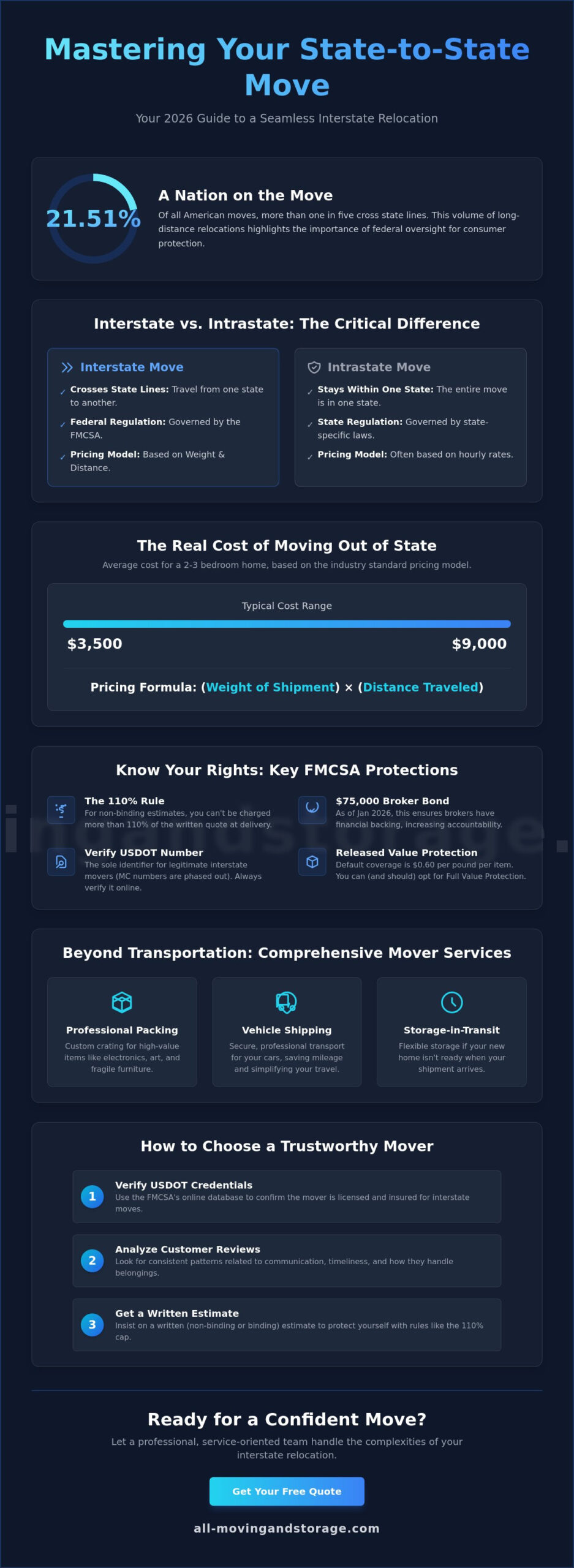
We’re here to help you move with total confidence. This guide provides the expert tips you need to master the complexities of interstate relocation in 2026. You’ll learn how to navigate the latest FMCSA regulations, including the 110% rule for non-binding estimates and the $75,000 minimum bond now required for brokers. We’ll also break down why the average 2 to 3 bedroom move costs between $3,500 and $9,000. By the end, you’ll know exactly how to verify a USDOT number to ensure a seamless, professional transition to your new home.
Key Takeaways
- Learn the critical differences between local and interstate moves and why federal FMCSA regulations protect your shipment.
- Discover how professional state to state movers use custom crating and full-service packing to secure high-value items during long-distance transit.
- Master the “Weight x Distance” pricing model to understand how tariff rates impact your final moving quote.
- Gain a step-by-step checklist for verifying USDOT credentials and analyzing reviews to avoid rogue operators and scams.
- Understand the unique benefits of choosing a family-owned, service-oriented partner for a seamless transition to your new home.
Understanding State to State Moving: What to Expect in 2026
Moving to a new state is more than just a change of address. It’s a major life transition that requires careful coordination and expert handling. In 2026, approximately 21.51% of all moves in the United States involve crossing state lines. This volume of activity has led to significant advancements in how professional state to state movers operate. Today, you can expect tech-enabled tracking for your shipment and digital inventory systems that ensure every box is accounted for. While the logistics are complex, the goal remains simple: a safe, efficient arrival at your new front door. Understanding the Moving Industry helps you see that professional oversight is the best way to manage the emotional and physical toll of a long-distance relocation.
Interstate vs. Intrastate: Why the Distinction Matters
The legal difference between a local move and an interstate move is significant. An intrastate move stays within one state’s borders and follows state-specific rules. However, as soon as a truck crosses a state line, it falls under federal authority. This distinction changes how your move is priced and regulated. Local moves often use hourly rates; however, state to state movers typically base their quotes on the weight of your items and the total distance traveled. For a typical 2 to 3 bedroom home, these costs generally range between $3,500 and $9,000. As of October 2025, the Federal Motor Carrier Safety Administration (FMCSA) phased out MC numbers. This means every legitimate interstate carrier must now be identified solely by a valid USDOT number. You should always verify this number to ensure your mover is legally authorized to operate across state lines.
The Role of Federal Regulations in Your Move
Federal laws exist to protect you from “rogue” operators and hidden fees. The FMCSA is the primary agency overseeing the moving industry. They require all movers to provide you with the “Your Rights and Responsibilities When You Move” booklet before the job begins. One of the most important protections is the “110% Rule” for non-binding estimates. This rule states that movers can’t charge you more than 110% of the original written estimate at the time of delivery. Any remaining balance must be billed after 30 days. Additionally, new regulations effective January 16, 2026, increased the financial responsibility for brokers to a $75,000 minimum bond. This ensures that companies coordinating your move have the financial backing to be held accountable. For your protection, federal law also sets “Released Value Protection” at $0.60 per pound per article, though you can always opt for full-value protection for higher security.
Comprehensive Services Offered by Professional State to State Movers
Professional state to state movers do far more than just load a trailer. They act as logistics partners who manage every technical detail of your relocation. Beyond standard transport, these companies offer specialized vehicle shipping for multi-car households. This service prevents unnecessary wear and tear on your cars and simplifies your own travel plans. Whether you’re driving or flying to your destination, your vehicles are handled with the same professional care as your furniture. The goal is a complete, all-in-one solution that covers every aspect of your move from your old driveway to your new one.
Professional Packing: The First Line of Defense
When you’re moving over 500 miles, the constant vibrations and shifts inside a trailer increase the risk of damage. This is why protecting your belongings with pro packing is a vital investment. Standard cardboard boxes are sufficient for clothing and linens, but high-value items require more. Professional teams use specialized crating for fragile electronics, oil paintings, and stone tabletops. These custom-built wooden shells provide a rigid barrier that resists impacts better than any double-walled box. Skilled packers ensure that every square inch of the trailer is utilized safely, which keeps your items from shifting during the long haul. If you’re concerned about specific fragile items, you can call us for a detailed service overview to see how we secure your valuables.
Integrated Storage Solutions for Long-Haul Gaps
The gap is real. One of the most common challenges in interstate relocation is when your moving truck arrives before your new home is ready for move-in. Professional state to state movers solve this problem with storage-in-transit (SIT). Unlike traditional long-term warehouse storage, SIT is a temporary, flexible solution. Your belongings stay in secure, climate-controlled containers for a short period, typically up to 90 days. This setup is a major strategic advantage. It eliminates the need for double-handling, which significantly reduces the chance of scratches or dents. Your items are moved once into storage and once out, keeping the process efficient and safe.
Managing these logistics requires a company that follows strict federal guidelines. Before you sign any contract, visit the FMCSA website to Protect Your Move by verifying that your carrier is authorized for both transport and storage. This extra step ensures your belongings are in the hands of a legitimate, insured professional. Whether you need a few days of bridge storage or a full-service packing crew, choosing a comprehensive provider makes the entire transition feel seamless and controlled.
Calculating the Real Cost of Moving Out of State
Transparency in pricing is essential for a stress-free move. Most state to state movers utilize a pricing model based on the total weight of your shipment and the distance to your destination. Industry data from April 2026 shows that moving a typical 2 to 3 bedroom home costs between $3,500 and $9,000. This price is heavily influenced by tariff rates, which are the standardized schedules of charges that movers must file with federal regulators. Understanding these rates helps you avoid surprises when the final bill arrives. It’s a structured system designed to ensure you only pay for the specific space and weight your items occupy on the truck.
Beyond the base weight and distance, several “accessorial charges” can impact your final quote. These include fuel surcharges, which fluctuate based on national averages, and physical labor fees like stair charges or long-carry fees. A long-carry fee typically applies if the mover must carry items more than 75 feet from the truck to your door. Timing also plays a massive role in your budget. With 45% of all moves occurring between May and August, booking during the off-peak season can lead to significant cost reductions. Planning your move for a mid-week date in the winter often results in more competitive pricing and flexible scheduling.
Binding vs. Non-Binding Estimates: What You Need to Know
Choosing the right estimate type is your best defense against “low-ball” offers. A non-binding estimate is a rough guess; the final price could skyrocket based on the actual weight. For 2026 relocations, the binding-not-to-exceed quote is the gold standard. This agreement ensures you won’t pay more than the quoted price even if the weight is higher, but you’ll pay less if the weight is lower. To get an accurate quote, ensure your inventory list is 100% complete. Every forgotten box or ottoman can lead to price adjustments on moving day. Professional estimators prefer conducting a virtual or in-person survey to ensure every item is accounted for before providing a final number.
Hidden Factors That Influence Interstate Moving Prices
Small details often add up during a long-haul journey. You may encounter charges for tolls and specific state-line permit fees that aren’t always obvious at first glance. Another critical factor is valuation protection. While the federally mandated “Released Value Protection” covers only $0.60 per pound per article, many families opt for Full Value Protection to ensure their high-value items are fully covered. This choice provides peace of mind that your belongings are financially secured. If you’re looking for ways to trim these expenses, check out our 2026 guide on moving long distance cheap for practical budgeting strategies. Using professional state to state movers ensures these costs are clearly outlined upfront, so you can plan your transition with total financial confidence.
How to Choose and Vet State to State Moving Companies
Vetting state to state movers is the most critical step in your relocation journey. In 2026, verification is simpler but requires your full attention. As mentioned earlier, the FMCSA phased out MC numbers in October 2025. This makes the USDOT number your primary tool for verification. A legitimate company will always provide this number and have a physical office address you can verify. Don’t rely solely on star ratings. Instead, read the detailed text of Google and BBB reviews to see how the company handles specific challenges like scheduling or claims. This gives you a clear picture of their actual service quality.
Watch out for companies asking for large cash-only deposits before the move. This is a major red flag that often signals a scam. Professional movers use official trucks with clear branding and permanent logos. If an unmarked rental truck arrives without prior notice, it’s a sign of a potential rogue operator. You should also demand an in-home or virtual survey before signing any agreement. Accurate long-distance planning is impossible without a detailed visual inventory. If a company gives you a quote over the phone without seeing your items, it’s likely they’ll add hidden fees later.
Carrier vs. Broker: Knowing Who is Actually Moving Your Stuff
Knowing who actually handles your belongings is vital for your peace of mind. A moving broker is a sales agent who sells your job to the highest bidder. They don’t own trucks or employ movers, which often leads to a lack of accountability if items are damaged or delayed. In contrast, a direct carrier like All American Moving and Storage manages the entire process from start to finish. We own the trucks and employ the skilled professionals who enter your home. Always ask, “Who owns the truck that will be at my door?” to ensure you aren’t dealing with a middleman. If you want to work directly with the team handling your goods, get a free quote from our certified carriers today.
Checking the Safety Record and Complaint History
You can research any company’s history using the FMCSA SAFER system. This portal reveals their safety rating and any formal complaints filed by previous customers. Look specifically for “Household Goods” (HHG) authorization. This specific certification confirms the mover is legally allowed to transport personal belongings across state lines and meets federal insurance requirements. The Bill of Lading is the most important contract in the moving process, serving as your official receipt and a binding agreement for the services provided. Checking these records ensures your move is handled by a company with a proven track record of safety and reliability.
Why All American is Your Trusted State to State Moving Partner
All American Moving and Storage stands out among state to state movers because we combine national reach with the accountability of a family-owned business. Large franchises often struggle with inconsistent service quality across different locations. We maintain a single standard of excellence for every long-distance relocation. Our team manages the entire process from our Florida headquarters, ensuring your belongings are handled with care by professionals who are directly answerable to us. This local ownership means we take a personal interest in the success of your move. We don’t just see a contract; we see a neighbor transitioning to a new life.
Our commitment to transparent pricing is the foundation of our service. We provide “no-surprise” quotes that clearly outline every cost, from the base tariff rates to any necessary accessorial charges. This approach eliminates the fear of hidden fees that often plagues the moving industry. Whether you are moving a small apartment or a large family estate, our goal is to provide a reliable and secure transition. We coordinate moves from Florida to any state in the US, providing the same level of dependable expertise regardless of the distance. You can trust that your belongings are in safe, capable hands from the moment we arrive until the final box is unpacked.
Expertise in Florida-Based Relocations
Navigating the unique logistics of South Florida requires specialized knowledge. We regularly serve communities in Weston, Davie, and surrounding areas. We understand the specific requirements of gated community associations and the strict scheduling rules of high-rise buildings in coastal cities. This local expertise is vital when planning a cross-country departure. If you’re still researching local options, check out your guide to choosing the best Fort Lauderdale moving company to see how we compare. Our deep roots in the region allow us to coordinate your move with precision and efficiency.
Start Your Journey With a Free Quote
Getting an accurate price shouldn’t be a guessing game. We offer both virtual and in-home estimates to provide a binding-not-to-exceed quote. During your consultation, we’ll walk through your home to identify high-value items that may need custom crating or specialized handling. To prepare for this session, create a list of items in “hidden” areas like attics, sheds, or crawl spaces. This ensures our state to state movers provide a quote that remains accurate on moving day. We believe in professional, straightforward communication that sets the stage for a successful relocation. Get your free state to state moving quote today! and experience a seamless transition to your new home.
Secure Your Move to a New State Today
A successful interstate relocation depends on thorough preparation and choosing the right partners. You now have the tools to verify USDOT numbers and understand the 110% rule for non-binding estimates. By prioritizing professional packing and vetting your state to state movers against federal safety records, you eliminate the risks of damage or hidden fees. These steps ensure your belongings arrive safely and your budget stays on track. Your transition should be a time of excitement, not unnecessary stress.
All American Moving and Storage is a family-owned and operated business in Florida. We’re fully licensed and insured for interstate commerce. Our team specializes in long-distance residential and commercial moves, ensuring every item is handled with care. We provide the dependable expertise you need for a seamless journey across state lines. Get a Free, No-Obligation State to State Moving Quote and let us manage the heavy lifting. We’re ready to help you settle into your new home with total confidence and peace of mind.
Frequently Asked Questions
How much do state to state movers cost on average in 2026?
The average cost to move a 2 to 3 bedroom home to another state currently ranges between $3,500 and $9,000. This price depends on the total weight of your shipment and the distance to your new home. For an accurate budget, always request a binding-not-to-exceed estimate to protect yourself from unexpected price hikes on delivery day.
How far in advance should I book my state to state move?
You should book your state to state movers at least 8 to 12 weeks before your desired move date. This is critical if you’re moving between May and August, as 45% of all annual moves occur during these months. Early booking ensures you secure a professional crew and have more flexibility with your preferred pickup and delivery window.
What is the difference between a moving carrier and a moving broker?
A moving carrier is a company that owns the trucks and employs the staff who handle your belongings. A moving broker is a sales agent that sells your move to a third party carrier for a fee. Working directly with a carrier provides better accountability and ensures the team at your door is the same one you hired.
Is my stuff insured during a state to state move?
Your belongings are covered by “Released Value Protection” at a rate of $0.60 per pound per article, which is the federal standard. For more comprehensive coverage, you can opt for Full Value Protection. This requires the mover to be responsible for the replacement value of any lost or damaged items in your shipment.
How long does it typically take for a state to state move to be completed?
Most interstate moves take between 3 and 14 days to complete depending on the total distance. A regional move of 1,000 miles usually takes 3 to 7 days, while cross-country relocations often require the full 14 day window. Your mover will provide a delivery spread rather than a specific arrival time for long-haul journeys.
What items are state to state movers not allowed to transport?
Movers are prohibited by law from transporting hazardous materials like propane tanks, aerosol cans, and ammunition. You should also plan to move perishables, plants, and high-value personal items like jewelry or legal documents yourself. Most state to state movers will provide a specific list of prohibited “non-allowable” items during your initial consultation.
Can I pack my own boxes for an interstate move to save money?
You can pack your own boxes to reduce your moving costs by approximately 25% to 35%. This “hybrid” approach is a popular way to save, but keep in mind that movers are generally not liable for damage to items inside boxes they didn’t pack. For fragile or expensive items, professional packing is the more secure option.
How do I verify if a state to state moving company is legitimate?
Check the company’s USDOT number on the Federal Motor Carrier Safety Administration (FMCSA) website to confirm they are active and insured. Ensure they have “Household Goods” authorization and a physical office address you can verify. Legitimate companies will never ask for a large cash deposit or provide a quote without a visual survey of your home.