
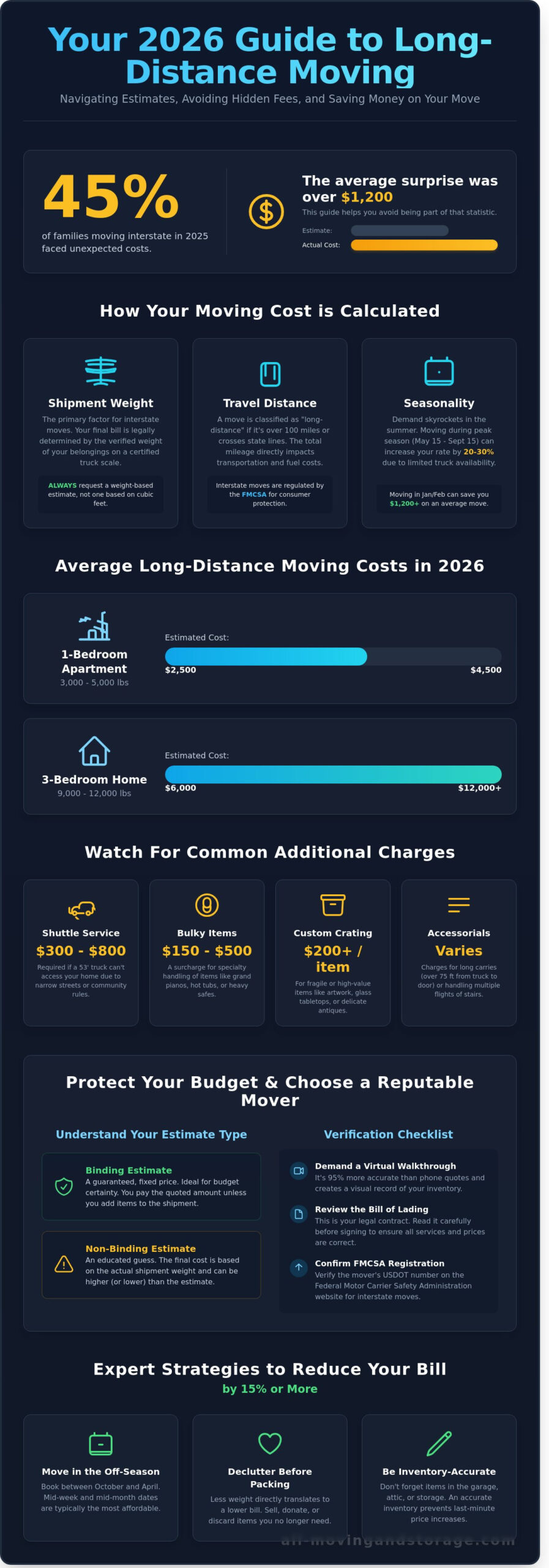
Did you know that 45% of families moving across state lines in 2025 ended up paying at least $1,200 more than their initial estimate? It’s a frustrating reality that often stems from confusing quotes and hidden fees that only appear once your life is packed into a truck. When you’re planning a major relocation for 2026, the last thing you need is a financial surprise. We understand that you’re looking for a reliable partner to ensure your heirlooms arrive safely without breaking your bank account.
To see how a dedicated team handles these complex variables, you can find out more about Long Distance Moving and the services they provide.
You deserve a predictable budget and total transparency regarding the cost of long distance movers. In this guide, we’ll provide a detailed breakdown of current pricing structures, explain the critical difference between weight and cubic feet estimates, and share a 7 point checklist to verify mover credentials. You’ll also learn three expert strategies that can lower your total relocation bill by 15% or more. From avoiding common delivery day surcharges to securing your most precious items, we’ve got the professional insights you need for a smooth, stress-free move.
Key Takeaways
- Understand how weight and mileage define your base rate to ensure you are billed fairly for any move over 100 miles.
- Get a clear 2026 pricing breakdown to help you budget the cost of long distance movers for everything from small apartments to large family homes.
- Learn the critical difference between binding and non-binding estimates to protect yourself from hidden fees and unexpected price hikes during transit.
- Discover expert strategies to reduce your bill, including the best times to schedule your move and how to declutter for maximum savings.
- See how a professional, service-oriented team ensures your items are handled with care through a transparent and reliable quoting process.
Understanding the Variables: What Determines the Cost of Long Distance Movers?
Moving across the country involves more than just loading a truck. In the moving industry, a relocation is officially classified as long-distance once it exceeds 100 miles or crosses a state line. This distinction is vital because it changes the legal framework governing your move. For a detailed moving industry overview, it’s helpful to recognize that these regulations are designed to ensure pricing transparency and cargo safety. When you begin researching the cost of long distance movers, you’ll find that the final number isn’t a flat fee but a calculation based on the weight of your belongings and the total mileage to your destination.
Interstate moves are strictly regulated by the Federal Motor Carrier Safety Administration (FMCSA). These companies must provide you with specific consumer protection booklets and follow federal tariff laws. Conversely, intrastate moves (moves staying within the same state) are governed by state-level agencies, such as the Florida Department of Agriculture and Consumer Services. In South Florida, specific logistics play a role in carrier availability. If you’re moving out of Weston or Davie, you’re located in a high-demand hub. While this means more trucks are often nearby, the gated communities and narrow streets in these areas often require smaller “shuttle” vehicles to transfer goods to a larger 53-foot trailer. This extra step can add $300 to $800 to your total bill depending on the volume of goods.
The Core Formula: Weight, Distance, and Time
The cost of long distance movers is legally bound to the weight of your shipment for all interstate relocations. You should be wary of any company that provides a quote based solely on cubic feet. Weight is the only objective metric that can be verified at a certified truck scale. Professional movers use a “tariff,” which is a comprehensive document outlining rates for transportation, fuel surcharges, and labor. This system ensures that two customers moving the same weight over the same distance receive comparable base pricing.
Timing is just as influential as weight. The moving industry experiences a massive surge in demand between May 15th and September 15th. During this peak season, rates typically spike by 20% to 30% due to limited truck availability. If your schedule allows, booking a move for the “off-season” months of January or February can save you over $1,200 on an average three-bedroom home relocation.
Inventory Accuracy: Why Your Quote Might Change
Accuracy during the estimating phase prevents surprises on moving day. An over-the-phone estimate is rarely sufficient for a long-distance move. In 2026, most reputable carriers insist on a virtual or in-person walkthrough to see the density of your furniture. If you forget to mention a heavy oak armoire or a garage full of power tools, your final price will increase when the truck hits the scales. High-value or heavy items require specialized handling that goes beyond standard labor. For example, moving a grand piano usually incurs a “bulky item” surcharge ranging from $150 to $500, while crating delicate antiques can add $200 per item for materials and custom construction.
- Virtual Walkthroughs: These are 95% more accurate than verbal inventories and provide a digital record of your items.
- Accessorial Charges: Costs for long carries (more than 75 feet from truck to door) or flights of stairs (typically after the first seven steps).
- Fuel Surcharges: Adjusted weekly based on national diesel averages to keep pricing fair for the carrier.
The Bill of Lading is the only legal contract that protects your price.
Average Long Distance Moving Costs in 2026: A Pricing Breakdown
Estimating the cost of long distance movers requires a look at the current 2026 economic environment. Moving expenses are largely dictated by the weight of your belongings and the total mileage between locations. For a standard 1-bedroom apartment, which typically weighs between 3,000 and 5,000 pounds, you should budget between $2,500 and $4,500 for a state-to-state relocation. Larger households face higher totals. A 3-bedroom home often weighs between 9,000 and 12,000 pounds, resulting in a price range of $6,000 to $12,000 or more depending on the final destination.
These figures represent base rates for transportation and standard loading. According to industry data regarding the average cost of movers, your final bill will fluctuate based on the specific “accessorial” services you select. It’s also vital to consider shipment protection. Federal law requires movers to provide basic released value protection at 60 cents per pound at no extra charge. However, this is rarely enough for valuable items. For instance, if a 100-pound television is damaged, you’d only receive $60. We recommend Full Value Protection, which covers the actual replacement cost of items, though it adds a premium to your initial quote.
Full-Service vs. Partial-Service Pricing
The level of involvement you choose significantly impacts your budget. Labor-only services are the most affordable, where you rent the truck and hire professionals just for the heavy lifting. Full-service moves are more common for long distances. These include professional packing, furniture disassembly, and transport. You can also choose between “curbside” delivery, where the crew leaves items at the entrance, and “white-glove” setup, which includes room-by-room placement and debris removal. To determine which service level fits your schedule, review our Cross-Country Moving Checklist before you request a detailed estimate.
Interstate Moving Surcharges You Must Know
Hidden fees can disrupt a moving budget if you aren’t prepared for 2026 surcharge standards. A “Long Carry” fee is triggered if the distance from the moving truck to your front door exceeds 75 feet. Similarly, “Stair” fees apply to multi-story apartment buildings without functional freight elevators. If your new neighborhood has narrow streets that cannot accommodate a 53-foot semi-truck, you’ll pay for a “Shuttle Service.” This involves transferring your goods to a smaller van and typically costs between $500 and $1,000 extra. Finally, fuel surcharges are a standard part of 2026 contracts. These are calculated as a percentage of your base rate, often fluctuating between 10% and 15% based on the national diesel price index at the time of your haul.
By understanding these variables, you can avoid surprises on delivery day. Accurate inventory lists are the best way to ensure your quote stays close to the final price. Professional movers use these lists to calculate weight more precisely, which helps stabilize the cost of long distance movers for your specific route.
Binding vs. Non-Binding Estimates: Which One Saves You Money?
The biggest fear for families moving across state lines is the “hostage load.” This occurs when a moving company provides a low initial quote but demands thousands of dollars in extra fees before they will unload your furniture at the new house. You can avoid this predatory practice by understanding the legal difference between estimate types. In 2026, transparency is your best tool for controlling the cost of long distance movers and ensuring a stress free relocation.
A Binding Estimate is the most reliable way to lock in your price. It’s a legal agreement that the total cost will not change, provided the inventory list remains identical to what you showed the estimator. If the truck weighs more than expected at the weigh station, the mover absorbs that cost, not you. It provides a fixed number for your budget, which is essential when you’re managing the high expenses of a cross-country transition.
Non-binding estimates are far riskier. These are simply “educated guesses” based on the estimated weight of your goods. Under federal law, carriers can legally demand payment for up to 110% of the non-binding estimate at the time of delivery. If you were quoted $6,000, the driver could demand $6,600 before opening the ramp. Any charges exceeding that 110% can be billed 30 days later, but you’re still responsible for the full amount eventually. For the best protection, look for a “Binding Not-to-Exceed” estimate. This consumer-friendly option ensures you never pay more than the quote, but if your shipment weighs less than predicted, your final price actually drops.
How to Read Your Moving Quote
Legitimate quotes must display the company’s USDOT number and MC number. You should verify these credentials through the FMCSA’s Protect Your Move guide to ensure the company is authorized for interstate transport. Be wary of “red flag” quotes that come in 30% or 40% lower than the industry average. These are often “lowball” estimates used by brokers to lure customers before handing the job to a third party who will hike the price later. For a step-by-step breakdown on identifying honest pricing, read our guide on How to Get an Accurate Long Distance Moving Quote.
Insurance and Valuation: Protecting the Investment
Every interstate move includes “Basic Release Value” protection at no extra cost. However, this only covers $0.60 per pound per item. If a 100-pound television worth $2,000 is destroyed, you would only receive $60 in compensation. This level of coverage is insufficient for a 1,000-mile journey where vibrations and road shifts are common. We recommend Full Value Protection (FVP) for any long-distance move. The cost of long distance movers usually increases by about 1% of the total declared value of your goods to include FVP. If you value your household contents at $75,000, expect to pay roughly $750 for comprehensive coverage. Before signing, ask the mover about their specific claims process and the typical turnaround time for settlements. Professional companies will have a clear, written protocol for handling damage reports.
Strategic Ways to Reduce Your Long Distance Moving Bill
Reducing the cost of long distance movers starts with understanding that your final bill isn’t set in stone. The total price relies on three primary factors: total weight, distance, and the specific services you select. While you can’t change the distance between Florida and your destination, you have full control over the other two variables. By making intentional choices during the planning phase, you can see a double-digit percentage drop in your final estimate.
The “Purge and Profit” strategy is the most effective way to lower your expenses. Moving companies charge based on the weight of your shipment. It’s often more expensive to pay for the transport of an old, heavy dining set than it is to sell it and buy a new one upon arrival. Beyond weight, timing plays a massive role. Booking a move for a Tuesday or Wednesday in the middle of the month can save you significantly compared to the high-demand periods of the first and last weekends. Most carriers offer lower rates during these “off-peak” windows because their crews and trucks aren’t at 100% capacity.
You should also consider the “hybrid” packing approach. While professional packing offers maximum security for fragile items like glassware or electronics, you can pack your own linens, books, and clothes to save on labor and material markups. For smaller shipments, ask about consolidated shipping. This method involves sharing truck space with other customers heading in the same direction. It might take a few extra days for delivery, but the savings compared to an exclusive-use van are substantial.
Downsizing for a Lower Weight Estimate
The math of a long-distance move is unforgiving. Every 1,000 lbs reduced can save roughly $800 to $1,200 on your total bill. If you’re moving from South Florida, utilize local resources like Faith Farm Ministries or the many estate sale liquidators in Broward and Palm Beach counties to offload heavy furniture. Before you pay to ship a 200-pound oak desk, calculate its replacement value. If the shipping cost exceeds 50% of the item’s worth, it’s more logical to sell it locally and pocket the cash for your new home setup.
Leveraging Storage to Control Timing
Timing gaps between your old lease ending and your new closing can lead to expensive “redelivery” fees if the truck has to wait. Using Secure Storage Solutions allows you to bridge this gap without the stress of a ticking clock. Storage-in-Transit (SIT) is a specialized service where your belongings stay on the truck or in a local warehouse for a short period, typically under 30 days. This is significantly cheaper than long-term warehouse storage, which involves unloading and reloading your items into a permanent vault. Proper use of SIT prevents the $500 to $900 fees often associated with failed delivery attempts or last-minute scheduling changes.
Planning your budget is easier when you have professional guidance. Our team helps you identify which items are worth shipping and which are better left behind to keep your cost of long distance movers as low as possible.
Choosing All American Moving And Storage for Your Cross-Country Move
All American Moving And Storage operates on a simple, firm principle: every item we touch is “Handled with Care.” As a family-owned company with over 25 years of experience, we don’t treat your belongings like bulk freight. We’ve spent decades refining our process to ensure your move is seamless and predictable. When you’re calculating the cost of long distance movers, you need a partner who provides more than just a truck. You need a team that manages every detail from the first box packed in Florida to the last item placed in your new home across the country.
Our commitment to transparency means you won’t face the “hidden fee” culture that plagues the moving industry. We provide clear, written estimates that account for every variable, including fuel, labor, and specialized packing materials. This honest approach has allowed us to maintain a 98 percent customer satisfaction rating through 2025 and into 2026. We believe that a successful move starts with trust, and trust starts with a fair price.
The Benefit of a Local Florida Expert
National brokers often sell your contract to the lowest bidder, which leads to delays, damaged goods, and total confusion. We take a different approach. Because we’re based in South Florida, we have deep roots in Weston, Davie, and Fort Lauderdale. We understand the specific logistics of these communities, from gated neighborhood regulations to the challenges of high-rise moves in downtown Fort Lauderdale. You can learn more about how our heritage impacts your experience by reading about Why Choose a Family-Owned Mover.
Working with a local expert offers several distinct advantages:
- Direct Communication: You’ll talk to real professional movers and local coordinators, not a representative in a distant call center.
- Personalized Logistics: We know the local traffic patterns and climate challenges, ensuring your departure is timed perfectly.
- Accountability: Our reputation in South Florida is our greatest asset. We’re your neighbors, and we’re held to a higher standard than a nameless national broker.
Ready to Move? Get Your Guaranteed Quote
Transparency is the foundation of our pricing model. Many homeowners worry about the final cost of long distance movers changing on delivery day. We eliminate that stress with a guaranteed quoting process. Whether you prefer a virtual walkthrough using your smartphone or a traditional in-home assessment, we provide a detailed inventory list and a firm price. This ensures there are no surprises when our team arrives to load the truck.
Our “Safe and Secure” guarantee sets us apart from the competition. Unlike larger carriers that might move your belongings between three different trucks during a cross-country trip, we prioritize consistency. Your items stay on our trucks and remain under the supervision of our trained staff throughout the entire long-haul transport. This significantly reduces the risk of loss or damage. If you’re ready to experience a move that’s handled with professional precision, GET A FREE QUOTE today. Our team is standing by to provide a no-obligation estimate tailored to your specific destination and timeline.
Take Control of Your Cross-Country Relocation
Navigating the 2026 moving market requires a clear understanding of how distance, weight, and timing impact your final bill. By prioritizing binding estimates and utilizing strategic packing methods, you can keep your expenses manageable. Calculating the cost of long distance movers is the first step toward a stress-free transition to your new home. You deserve a partner that brings decades of expertise to the table. Reliability matters when you’re crossing state lines.
All American Moving and Storage has been family-owned and operated for over 20 years. We are fully licensed and insured with verified MC/DOT credentials to ensure your belongings remain secure throughout the journey. Our team specializes in South Florida departures from Weston and Davie, providing the localized knowledge needed for a seamless exit. We handle every item with care and professionalism so you can focus on your next chapter. Don’t leave your move to chance when you can rely on proven experts who understand the industry inside and out.
Ready to start your journey? GET A FREE LONG-DISTANCE MOVING QUOTE today. We look forward to making your move a success.
Frequently Asked Questions
How much should I tip long-distance movers in 2026?
You should plan to tip each mover between $40 and $60 for every full day of work performed during your long-distance relocation. For a standard three-bedroom home, this usually totals about 15% of the labor portion of your final bill. You can distribute the cash to the crew after they finish loading the truck or when they complete the delivery at your new home. Tipping is a professional way to reward a crew that handles your fragile items with care and efficiency.
Is it cheaper to rent a truck or hire long-distance movers?
Renting a truck is roughly 50% cheaper upfront, but the total cost of long distance movers often provides better value when you calculate fuel, lodging, and insurance. A 26-foot rental truck for a 1,000-mile move can cost $2,500 in 2026 once you include the $0.99 per mile fee and current diesel prices. Professional services eliminate the risk of personal injury and ensure your property is protected by certified experts throughout the journey.
How far in advance should I book my long-distance move?
You should book your long-distance move at least 12 weeks in advance if your dates fall between May and September. For moves scheduled during the winter months, a lead time of 8 weeks is usually enough to secure a reliable crew. Booking early allows you to lock in 2026 rates and avoids the 20% price surge that often applies to last-minute reservations made within 14 days of a move. This lead time ensures your transition is handled by a dependable team.
What is the average cost of a move from Florida to New York?
The average price for a professional move from Florida to New York in 2026 ranges from $4,800 to $9,200 for a standard two-bedroom residence. This estimate covers the 1,100-mile transport, fuel surcharges, and standard liability protection for your belongings. Your final quote depends on the total weight of your inventory and any specialized requirements like piano or antique moving. Choosing a Tuesday or Wednesday for your move can reduce this total by $400 compared to weekend rates.
Can I negotiate the price with long-distance moving companies?
You can negotiate your rate by requesting a price match for a written estimate from another certified carrier or by asking for seasonal promotions. Most companies offer a 5% to 10% discount for seniors, active military members, and AAA participants. Another way to lower the cost of long distance movers is to purge heavy furniture or appliances before the final walkthrough. Providing a flexible three-day delivery window can also result in a $300 credit on your final invoice.
What items are forbidden on a long-distance moving truck?
Federal safety regulations prohibit movers from carrying hazardous materials such as propane tanks, aerosol cans, ammunition, and liquid bleach. You must also transport perishable foods and living plants in your own vehicle because they cannot survive a multi-day trip in a standard trailer. Most carriers provide a list of over 25 prohibited household chemicals to ensure the safety of the crew and your cargo. It’s best to donate these items or dispose of them at a local facility before moving day.
Does insurance cover my items if I pack the boxes myself?
Standard liability insurance only covers 60 cents per pound for items you pack yourself, which means a damaged $1,200 television might only result in a $30 reimbursement. Most full-value protection plans require professional packing for fragile items like glassware or electronics to remain valid. If you pack your own boxes, the moving company is only responsible if there’s clear evidence of external damage to the carton caused by the movers. Our skilled team can handle the packing to ensure your items are fully protected.
How long does a long-distance move typically take from South Florida?
A long-distance move from South Florida typically takes between 4 and 12 business days depending on the mileage to your destination. For instance, a move to Atlanta usually takes 3 days, while a cross-country trip to Seattle requires 10 to 14 days to comply with Department of Transportation safety rules. Federal law limits drivers to 11 hours of driving within a 14-hour window, which affects the delivery timeline. We provide a specific delivery window so you can coordinate your arrival at your new home.