
On a Tuesday morning in July 2026, you watch the movers close the truck doors, only to be handed a final bill that is $1,940 higher than your initial quote. This “hostage load” scenario is a documented reality for many families who don’t understand the legal nuances of a binding vs non binding moving estimate. Choosing the wrong contract type can turn a carefully planned $4,500 budget into a financial crisis before you even arrive at your new home.
You deserve to feel certain that your belongings are in safe, professional hands without fearing a price hike on moving day. It’s common to feel overwhelmed by technical contract language, but knowing the rules helps you stay in control. We’ll show you how to lock in your moving costs and avoid the common traps that lead to unexpected fees. This guide explains the three main estimate categories and provides a clear path to ensure your 2026 relocation stays on budget and stress-free.
Key Takeaways
- Understand why a written estimate is a legal requirement under federal law and how it protects you from unexpected moving day surprises.
- Navigate the critical differences of a binding vs non binding moving estimate to choose the pricing model that best fits your 2026 budget.
- Explore why a “Binding Not-to-Exceed” estimate is considered the gold standard for long-term price protection and consumer safety.
- Identify hidden “accessorial charges”—such as fees for stairs or long carries—that can impact your final cost if not disclosed upfront.
- Learn how to provide a complete inventory to your mover to ensure your final price remains accurate, dependable, and transparent.
What is a Moving Estimate? Understanding the Basics
A moving estimate is a written document that projects your total relocation costs based on item weight and requested services. Federal law, specifically 49 CFR § 375.401, requires every interstate mover to provide this in writing. It’s not a casual conversation. This document acts as the legal foundation for your Order for Service and the final contract. Choosing between a binding vs non binding moving estimate in 2026 determines your specific legal protections and how much your final price can deviate from the initial quote.
Why Estimates Aren’t Just About Price
An estimate defines the scope of work. It outlines exactly what items will be transported and which professional services, like packing or crating, are included. This structure prevents scope creep, which happens when extra tasks are added during the move without prior agreement. A moving estimate is a legally binding disclosure of service costs. It ensures both you and the mover have a clear, reliable roadmap for the entire process, which keeps your belongings secure and your budget intact.
The Role of the Inventory (Cube Sheet)
Every estimate relies on a detailed inventory, often called a cube sheet. This list tracks the volume and weight of every chair, box, and appliance. Reliability varies depending on how the mover gathers this data. Digital surveys or in-person walkthroughs are now the industry standard. Moving industry data from 2024 indicates that professional walkthroughs reduce billing disputes by 22% compared to over-the-phone guesses.
Accuracy is vital. If you overlook the items in your attic or the heavy tools in your garage, the mover can void the original agreement on moving day. When the actual weight exceeds the inventory list, your binding vs non binding moving estimate protections might change. Clear documentation keeps your move efficient and ensures your belongings are handled with professional care. Detailed lists prevent the stress of last-minute price hikes.
- Written Requirement: All interstate moves must have a written estimate per FMCSA regulations.
- Legal Foundation: The estimate transitions into the Order for Service.
- Service Scope: Defines exactly what is being moved to avoid hidden fees.
Binding vs. Non-Binding Moving Estimate: The Core Differences
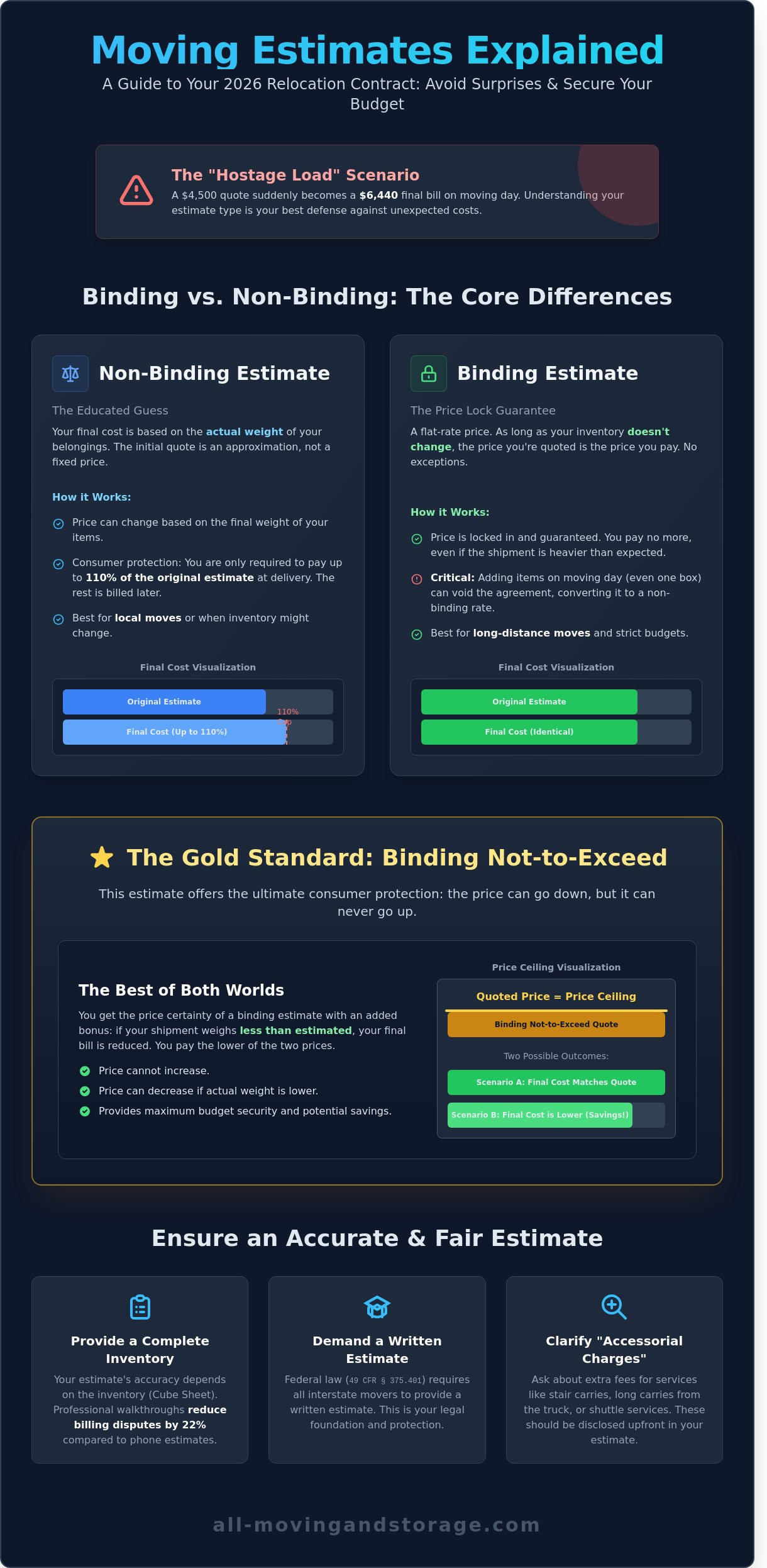
Choosing between a binding vs non binding moving estimate defines how you’ll manage your 2026 relocation budget. A binding estimate acts as a flat-price guarantee. It locks in the total cost for a specific list of items and services. If your inventory remains identical from the initial walkthrough to moving day, your price won’t budge. Conversely, a non-binding estimate is an educated guess. Your final bill depends on the actual weight of the shipment or the total hours worked by the crew.
Understanding these differences helps prevent unexpected costs during a stressful time. Professional movers use these two frameworks to balance risk and accuracy. While one offers a fixed price, the other provides flexibility based on the real-time scale of the job. Most reputable companies will offer both options depending on whether you’re staying in Florida or crossing state lines.
The Mechanics of a Binding Estimate
A binding agreement provides total price certainty. If your shipment weighs more than the mover projected, you don’t pay a penny extra. It’s a secure way to plan for long-distance relocations where weight costs can escalate quickly. However, there’s a strict catch. If you add a single armchair or five extra boxes on moving day, the mover can void the original contract. They’ll either issue a revised quote or switch you to a non-binding rate. This option is best for organized movers who have a finalized inventory list and don’t plan on adding items at the last minute.
The Reality of Non-Binding Estimates
Non-binding quotes are standard for local moves in Weston or Davie, where hourly rates often apply. These estimates rely on the actual net weight of your goods or the time spent loading and unloading. Federal law protects consumers through the 110% Rule. This regulation states that a mover can’t demand more than 110% of the original estimate at the time of delivery. If the final cost exceeds that amount, the company must deliver your goods and bill you for the remaining balance 30 days later.
You can request a professional walkthrough to ensure your initial quote is as accurate as possible. Be cautious of “lowballing” tactics. Some companies provide artificially low non-binding quotes to win business, knowing the final price will be higher. To stay safe, always compare quotes based on the weight or hours estimated, not just the bottom-line price.
- Binding Estimates: Best for long-distance moves and strict budgets.
- Non-Binding Estimates: Best for local moves with flexible inventories.
- The 110% Rule: A legal cap that prevents movers from holding your items hostage for more than 10% over the quote.
The Gold Standard: Binding Not-to-Exceed Estimates
The Binding Not-to-Exceed estimate, also known as a Guaranteed Not-to-Exceed quote, represents the most reliable pricing model for your 2026 relocation. This hybrid approach eliminates the guesswork that often plagues standard contracts. It functions as a legal price ceiling that protects your bank account while allowing for potential savings. When you evaluate a binding vs non binding moving estimate, the Not-to-Exceed option stands out because it offers the security of a fixed price without the rigidity that prevents you from paying less if your load is light.
All American Moving and Storage recommends this format for every residential client. It builds a foundation of trust from the first day of the process. In a 2024 industry report, the FMCSA noted that transparent pricing models like these reduced consumer billing disputes by 15% compared to traditional estimates. By choosing this “gold standard,” you ensure that your final invoice is predictable, professional, and fair.
How ‘Not-to-Exceed’ Protects Your Budget
This estimate type functions on a simple principle of fairness. If your household goods weigh less than the original estimate on the certified scale, you only pay for the actual weight moved. Conversely, if your items weigh more than the initial inventory suggested, your price stays locked at the original quote. This estimate type places the risk on the mover, not the customer.
- Weight Reductions: If your 7,000-pound estimate turns out to be 6,200 pounds, your bill decreases accordingly.
- Price Caps: You’re never surprised by “overweight” fees that can add $500 or more to a standard bill.
- Contractual Certainty: The mover cannot exceed the quoted price unless you add specific services or items after the contract is signed.
When to Insist on a Not-to-Exceed Quote
You should demand a Not-to-Exceed quote for any long-distance move exceeding 500 miles. Weight is notoriously difficult to guess accurately; even a 10% error in judgment can lead to hundreds of dollars in unexpected costs during a binding vs non binding moving estimate comparison. Reputable Florida movers prefer this model because it demonstrates their commitment to accuracy and skilled logistics. It shows the company is confident enough in their estimators to stand behind their numbers.
To identify this protection, look for specific language in your moving contract. It should clearly state “Price Not to Exceed” or “Guaranteed Maximum Price.” If the document only says “Binding,” you might lose out on savings if your shipment is light. If it says “Non-Binding,” you have no protection against price hikes. Always check for the mover’s signature next to the “Not-to-Exceed” clause to ensure it’s legally enforceable for your 2026 move.
Ensuring Your Moving Estimate is Accurate
Transparency is the foundation of a reliable move. You must show your mover every item, including those tucked away in the attic, the garden shed, or the back of a walk-in closet. Omitting a single storage unit can increase your final cost by 20% or more once the crew arrives. When you are weighing the pros and cons of a binding vs non binding moving estimate, your honesty ensures the price you are quoted remains the price you pay. Hidden inventory always leads to last-minute price hikes.
The Importance of the Visual Survey
All American Moving and Storage recommends an in-person walkthrough or a detailed video survey for every residential client. Phone-only quotes are a significant red flag. Rogue movers often use vague phone estimates to provide low-ball prices, only to add massive fees once your goods are locked on their truck. During your walkthrough, ask the estimator how they handle bulky items and if they have experience with the narrow, tree-lined streets in Davie or the strict access rules of South Florida gated communities. A professional estimator will spot these challenges immediately.
Decoding Hidden Fees and Add-ons
You need to understand the difference between packing materials and packing labor. A specialized dish barrel box might cost $10.00, but the professional labor to pack it is a separate hourly or per-box charge. You should also evaluate your valuation coverage options. Basic carrier liability only covers $0.60 per pound. This is rarely enough for high-value electronics or modern furniture. If your home has more than two flights of stairs or if the truck must park more than 75 feet from your front door, expect accessorial charges like stair fees or long carry fees to appear on your binding vs non binding moving estimate.
- Long Carry Fees: Applied if the distance from the truck to your door exceeds 75 feet.
- Stair Fees: Often charged per flight after the first two floors.
- Elevator Fees: Common in South Florida high-rises where freight elevator wait times are long.
- Shuttle Services: Necessary if a full-sized semi-truck cannot fit down a narrow Davie residential street.
To avoid surprises, you can use All American Packing Services to ensure your items are professionally prepared before the truck arrives. This helps keep your labor hours predictable and your final bill manageable.
Get a Reliable Quote from All American Moving and Storage
All American Moving and Storage brings 27 years of family-owned experience to every South Florida relocation. We understand that choosing between a binding vs non binding moving estimate is about more than just numbers. It’s about certainty. Our team eliminates guesswork by providing detailed walkthroughs for homes in Weston, Davie, and Fort Lauderdale. We don’t believe in vague figures that change on moving day. Instead, we offer 100% transparency rooted in our local values. We’ve served over 15,000 families since our founding, and our reputation depends on your satisfaction.
The All American Difference
We’ve built a reputation on a strict no-hidden-fee policy. Whether you’re moving across town or across the country, the price we discuss is the price you pay. Our certified crews are trained specifically for high-value items. In 2024 alone, we successfully moved over 450 pianos and delicate antiques without a single damage claim. Local residents in the 33326 and 33331 zip codes trust us because we know the specific logistics of South Florida gated communities and high-rise buildings. Our commitment to care includes:
- Expert Packing: We use high-grade materials to protect fragile belongings.
- Specialized Equipment: Our trucks feature air-ride suspension for smooth transport.
- Skilled Professionals: Every crew member is background-checked and professionally trained.
One Davie resident recently shared that their move was completed three hours ahead of schedule, with every item placed exactly where they requested. This level of efficiency is why we remain a top-rated choice for 2026 moves.
Ready to Start Your Move?
Scheduling your estimate takes less than five minutes. You can choose a traditional in-home visit or a convenient virtual walkthrough using your smartphone. This ensures you receive a precise binding vs non binding moving estimate tailored to your specific inventory. To make the process as smooth as possible, please have the following information ready:
- Your preferred moving date and a backup date.
- The full address of your current home and your new destination.
- A basic inventory list of large furniture and specialty items.
Our estimators provide a comprehensive breakdown of costs, so you aren’t hit with unexpected surcharges for stairs or long carries. We prioritize clear communication from the first phone call to the final box delivery. Take the stress out of your 2026 relocation and partner with a team that treats your belongings like their own.
Plan Your 2026 Relocation with Total Price Certainty
Your 2026 move doesn’t have to be a source of financial stress. Understanding the core differences of a binding vs non binding moving estimate is the first step toward a predictable budget. A binding estimate locks in your price based on a fixed inventory list. Conversely, a non-binding quote shifts depending on the final scale weight of your shipment. For the most protection, choose a binding not-to-exceed agreement. This ensures you never pay more than the original quote even if your items weigh more than the initial projection.
All American Moving and Storage brings over 20 years of expertise as a family-owned company in South Florida. We’re fully insured and licensed for long-distance moves across all 50 states. Whether you need to transport a 500-pound grand piano or a delicate 19th-century armoire, our specialized teams handle every item with professional care. Don’t leave your costs to chance when you can work with certified experts who prioritize your peace of mind.
Secure your guaranteed moving quote with All American Moving and Storage today!
We look forward to making your next transition smooth and successful.
Frequently Asked Questions
Can a moving company change a binding estimate?
A moving company cannot change a binding estimate once it’s signed unless you add items or services not listed in the original agreement. If you add 10 extra boxes or a heavy appliance on moving day, the mover will provide a revised estimate before loading your shipment. According to Federal Motor Carrier Safety Administration (FMCSA) guidelines, this ensures you only pay for the specific inventory agreed upon. This protection makes binding quotes a reliable choice for budget-conscious families.
What happens if my shipment weighs more than a non-binding estimate?
You are responsible for paying the total cost based on the actual weight of your shipment if it exceeds the initial projection. Under federal law, you only have to pay 110% of the estimated cost at the time of delivery to receive your goods. You’ll then have 30 days to pay the remaining balance. This is a key factor when comparing a binding vs non binding moving estimate for your 2026 relocation.
Is a binding estimate always more expensive than a non-binding one?
A binding estimate isn’t always more expensive, but movers often include a 7% to 15% price buffer to account for potential weight fluctuations. While a non-binding estimate might look cheaper on paper, it carries the risk of price hikes once the truck hits the scales. Choosing a binding quote provides price certainty, ensuring your final bill doesn’t jump by $500 or $1,000 unexpectedly. It’s the most dependable way to manage your moving budget.
How do I know if my moving estimate is legally valid?
Your estimate is legally valid if it’s provided in writing, dated, and signed by both you and the mover. Federal regulation 49 CFR § 375.401 requires interstate movers to perform a physical or virtual survey of your goods before issuing a quote. Ensure the document clearly states whether it’s binding or non-binding. We recommend keeping a digital copy and a printed version during your 2026 move to prevent disputes. This documentation acts as your primary protection.
Should I ever accept a moving estimate over the phone?
You shouldn’t accept a moving estimate over the phone because it lacks the accuracy of a visual inspection. Professional movers need to see your 3-bedroom home or 1,200-square-foot apartment to assess the volume and weight of your belongings. Phone quotes often lead to 20% or 30% price increases on moving day. Always insist on an in-person or video survey to ensure your quote is reliable and compliant with 2024 consumer protection standards.
What are accessorial charges and why are they on my estimate?
Accessorial charges are fees for additional services beyond the basic transport of your goods. These include packing services, flights of stairs, or long-carry distances if the truck can’t park within 75 feet of your door. For example, a mover might charge $75 for an extra flight of stairs or $150 for a shuttle service. Understanding these costs helps you evaluate a binding vs non binding moving estimate more effectively before signing your contract.
What is the 110% rule in moving?
The 110% rule is a federal regulation protecting you from excessive charges on non-binding estimates. It states that a mover can’t demand more than 110% of the original estimate at the time of delivery. If your final bill is $2,000 but the estimate was $1,000, you pay $1,100 to get your items. You’ll then have a 30-day grace period to settle the remaining $900 balance with the company. This rule ensures your belongings aren’t held hostage.
How long is a moving estimate valid for in 2026?
Most moving estimates in 2026 are valid for 30 to 60 days from the date they’re issued. Fuel costs and seasonal demand cause rates to fluctuate; movers set these expiration dates to maintain profitability. If you wait 90 days to book your move, you’ll likely need a new quote to reflect current labor and transportation prices. We suggest locking in your rate at least 45 days before your scheduled move date to ensure availability and price stability.